


Key takeaways
- Most homeowners decide how to pay for a renovation twice. Once before the first contractor arrives, and again mid-project when the budget runs over.
- Think hard before a project takes your emergency fund with it. That’s one of the better reasons to borrow against the house instead.
- The five ways of paying aren’t equal. You’ll pay far less interest on money borrowed against your home than on a credit card or a personal loan.
- Refinancing isn’t the only way to reach your equity anymore, and for a lot of people it isn’t the obvious one.
- A line of credit is a limit, not a lump sum. Size it for the project that runs over.
I was talking with someone recently who had spent three years saving for her kitchen. She had the number written down and she was proud of it, as she should have been. Then the work started, the old floor came up, and the number stopped being the number. That happens on most projects, and it’s the part almost nobody plans for.
Last week we went through which fall projects pay you back and which ones people regret. A lot of you wrote back with the same question, and it had nothing to do with garage doors. You wanted to know how to pay for it, so let’s talk that through. It’s the decision I watch people rush more than any other.
The decision you make twice
Most people decide how they’ll pay for a renovation before getting a single estimate on the table. There’s a number in mind, and a plan for where it comes from. Then the tile is out of stock, or a wall comes down and something behind it needs attention, or the kitchen turns out so well that the hallway suddenly looks tired.
37% of homeowners spend past the budget they set, and most of them do it on purpose, choosing better materials or widening the scope once they can see the work taking shape. Those are usually good calls made for good reasons, but they do mean the money question gets asked twice.
The first decision happens at the kitchen table, with time to think it over. The second happens in week three, with a contractor standing in a half-finished room waiting on an answer. That second decision almost always costs more, not because the project changed, but because there was no time to think it through. That’s why I’d rather you had all of this before anyone quotes you, instead of after.
What people actually use
Most renovations get paid for out of savings, and there’s nothing wrong with that. It’s where I’d start too. What’s changed is how people cover the rest.
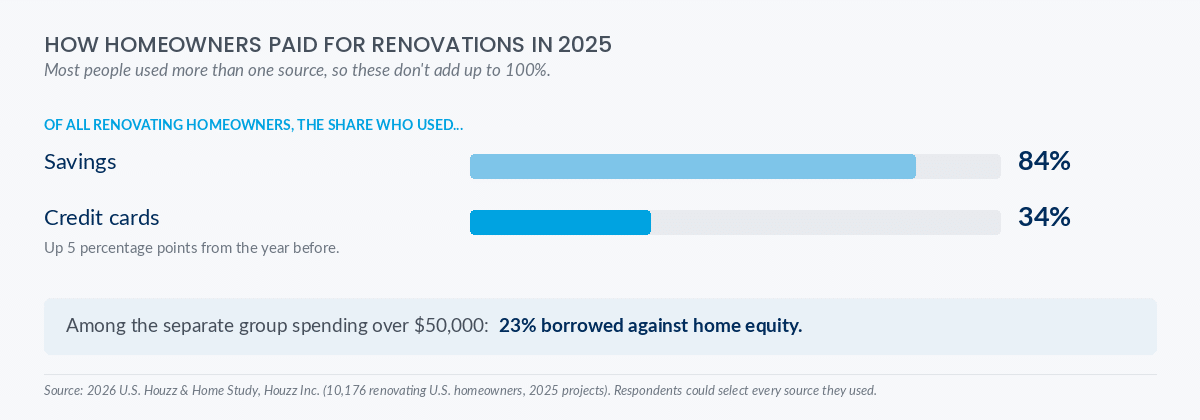
Credit cards now pay for part of the work on more than a third of projects, and that share climbs every year. Hardly anyone plans it that way. It happens partway through, when the money runs short and someone needs an answer the same day, and a credit card is the quickest thing in the wallet.
Most renovations get funded from more than one place, which is why the numbers in that chart add up past a hundred. Savings covers the bulk of it and something else covers the rest, and that something else is the part I’d want you choosing on purpose rather than by default.
The five ways people pay for it
These five ways of paying aren’t equal, and I’d rather say so plainly than pretend otherwise. Your own savings cost you no interest at all. Borrowing against your home costs some. A credit card or a personal loan costs the most, by a wide margin.
Savings. No lender, no paperwork, no lien on the house, and no interest to pay. Hard to beat when the money is sitting there.
The one thing I’d think about first is your emergency fund. That money already has a job. It covers a job loss, a failed water heater, a transmission. Spending it on a kitchen doesn’t make the next emergency any less likely, it just means you’ll be meeting that emergency with an empty account.
So if paying cash would clean you out, that’s a good reason to borrow against the house instead. You keep the cushion and the project still gets done.
A high-interest credit card. Fast, flexible, backed by nothing, and the most expensive way to pay for any of this. The speed is the whole appeal, and it’s also the trap.
The interest on a credit card buys you nothing. It doesn’t go into the house, it doesn’t come back at resale, and it isn’t building anything for your family. It leaves the account every month, and at credit card rates it leaves fast, which is why a credit card that started as a stopgap so often turns into the main thing you’re paying off.
There’s one narrow case where it works: something small you’ll clear in a couple of months, or a promotional rate you’ll pay off before it expires. Outside of that, a credit card becomes a bridge people end up living on, and I’ve had that conversation more times than I’d like.
A personal loan or contractor financing. Unsecured, so your house isn’t attached to it, and it’s usually quick. Nothing is backing it up though, so the interest runs much higher than a loan against your home, and you feel that difference every month for years.
Contractor-arranged financing is the one I’d read slowly, because the paperwork comes from the same people who want you to say yes to the bid. Ask who the lender actually is, and ask for the total cost over the full life of it in writing.
A home equity line or loan. On a bigger project, this is usually what we end up talking about. It’s a second loan that sits behind your existing mortgage and leaves that mortgage exactly as it is.
A line is at its best when the work happens in stages. You get a limit, you draw what you need as the job moves, and you only pay interest on what you’ve actually drawn. A loan is at its best when you already know the number: one defined job, one lump sum, one schedule.
What makes a home equity line or loan cheaper is straightforward. Your home is backing it, so the interest rate runs far below a credit card or a personal loan. On a renovation that takes a year or two to pay off, that difference adds up to real money.
A cash-out refinance. Sometimes the cheapest option depending on your scenario. You replace your existing mortgage with a larger one and take the difference, so everything stays on a single payment and a single schedule. It’s also the route that generally allows the largest loan-to-value.
The part that surprises people
For years there was one answer to “how do I get at the equity in my house,” and that answer was refinance. It’s still a good answer for plenty of families. It just isn’t the only one now, or even the usual one.
A lot of homeowners are sitting on a first mortgage they’d rather not touch. Companies who track this across most of the country, call it the lock-in effect. Earlier this year more than half of the equity homeowners took out came through second loans instead of refinancing, the strongest showing for second loans in almost twenty years. If you bought or refinanced between 2020 and 2022, there’s a fair chance I’m describing you.
Neither route wins by default. A refinance can be the cleaner move, especially if you’re not attached to your current mortgage or you’d rather keep everything in one place. What’s different now is that a second loan sits right beside it as a real choice, where a few years ago I’d have pointed almost everyone straight at refinancing. That’s what people get wrong on their own, and it’s what we can usually settle in one conversation.
Size the line for the project you’ll actually have
A home equity line of credit is a limit, not a lump sum. That makes choosing the size of the limit a separate decision from choosing how much to spend, and it’s the one I see homeowners size too small.
Set the limit against the project that runs over, not the one on the estimate. If there’s room in the line, week three costs you a phone call. If there isn’t, you’re applying for something in the middle of a build, and that’s where the expensive choices get made.
Ask me what affects the size of a line, and what fees come with keeping one open. Those vary, and they’re the part to understand before you settle on a number.
Using equity is simpler than people expect
A lot of homeowners put off calling a lender about their equity because they picture buying a house all over again, months of it, boxes of paper. Borrowing against a home you already own really isn’t that.
You already own the home. You already have the mortgage. The questions are about a property you know and a loan you’ve been paying on, and much of what I’ll ask for is paperwork already sitting in a drawer. That equity has been building the whole time your family has lived there, and putting a little of it back into the house is one of the most ordinary things a homeowner does with it.
Before you sign: a short checklist
Run through these questions before you sign a contractor’s contract, not after. Take them to whoever you’re talking to about money.
- ☐ Write down your number, then add 20%. Plan for the version of this project that runs over, because that’s usually the one you get.
- ☐ Decide now where the extra would come from. Make that second decision with time to think, instead of in week three.
- ☐ Check what’s left in savings when the work is done. If the answer is “not much,” that’s an argument for using equity rather than emptying the account.
- ☐ Ask whether this is one job or several. Staged work and a single defined job suit different options.
- ☐ If a contractor offers financing, find out who the lender actually is. Get the total cost over the full life of it in writing first.
- ☐ Ask whether your current mortgage is one you’d want to keep. For a lot of people it is, and that rules some options in and others out.
- ☐ Ask what’s backing each option. Nothing backs a credit card or a personal loan, so they charge the most interest. Your home backs a refinance or a second loan, so they charge a lot less.
- ☐ Ask what happens if the project stalls. There are answers for a delayed crew, a job that changes halfway through, and money released in stages. Get those answers before you need them.
Questions I get asked
Should I just put it on a credit card and pay it off fast? If fast really means a couple of months and you know the money’s there to do it, that can work. The trouble is that nearly everyone intends exactly that, and the balance tends to outlive the project by years. At credit card rates, that’s the most expensive version of this project there is.
Is it smarter to wait until I’ve saved the whole amount? It depends what the work is doing. A cosmetic refresh can wait, but anything holding back damage can’t, and waiting on that one usually costs more than using equity would have.
There’s also a cost to waiting that never shows up on paper. While you save, the project competes with everything else your savings is there for, prices don’t stand still, and if something gives out in the meantime it tends to land on a high-interest credit card anyway.
Can I use more than one of these? Yes, and most people do. Savings for the bulk of it, something else for the rest. The trouble starts when a high-interest credit card becomes the main source without anyone actually deciding it should.
Does it need to add value to be worth doing? No. Resale value is one way to judge a project, not the only one. Some of the best projects I’ve helped with were about living in the house rather than selling it. Just be clear with yourself about which one you’re doing.
Where to start
If you’re weighing something this fall, start with a conversation about which of these five fits your situation. It’s usually a short call, and it’s a good deal easier than most people expect. That’s the whole reason I put this together.