

Financial Planning

Foreclosure and Bankruptcy: Can You Still Qualify for a Mortgage?

Foreclosure and Bankruptcy: Can You Still Qualify for a Mortgage? 764 525 Your Loan Officer for Life

Key Takeaways

  • How bankruptcy and foreclosure actually happen, and why lenders treat them as recoverable events 
  • Waiting periods by loan program: FHA, VA, USDA, and Conventional 
  • The difference between “discharge” and “dismissal,” and why it changes your timeline 
  • How to rebuild your credit profile during the waiting period so you’re ready the moment it ends 


If bankruptcy or foreclosure is part of your financial history, you may have written off homeownership entirely. That assumption is usually wrong. Lenders don’t view a past bankruptcy or foreclosure as a permanent disqualifier — they view it as an event with a waiting period attached, and once that period passes, you’re evaluated the same as any other borrower on your current credit, income, and savings. 

The waiting period is real, and it varies significantly depending on which loan program you’re targeting and how the bankruptcy or foreclosure was resolved. This guide breaks down exactly what those timelines look like and what to do while you wait. 

How Foreclosure and Bankruptcy Actually Happen 

Most foreclosures trace back to an extended period of missed payments, often triggered by job loss or a sudden financial shock rather than mismanagement. When a mortgage payment is missed and not resolved, the lender can eventually take the property through foreclosure and sell it to recover the debt. If the sale price doesn’t cover what’s owed, the remaining balance is called a deficiency — and if there’s no realistic way to pay that deficiency, it often leads to a bankruptcy filing. 

Bankruptcy itself typically comes in one of two forms for individuals: 

  • Chapter 7 — assets are liquidated to discharge (eliminate) debt, including in some cases a mortgage and home 
  • Chapter 13 — debt is reorganized into a court-approved repayment plan rather than eliminated outright 


Not every bankruptcy involves a foreclosure, and not every foreclosure leads to bankruptcy — but when they happen together, lenders have specific, well-documented paths back to loan eligibility once enough time has passed. 

Waiting Periods by Loan Program 

This is the part that actually determines your timeline, and it’s where working with a lender who underwrites across multiple programs matters — a timeline that rules you out on one program may not apply to another. 

FHA Loans 

  • Chapter 7 bankruptcy: typically 2 years from discharge 
  • Chapter 13 bankruptcy: as early as 1 year into a satisfactory repayment plan, with court approval 
  • Foreclosure: typically 3 years from the completion date 


VA Loans 

  • Chapter 7 bankruptcy: typically 2 years from discharge 
  • Chapter 13 bankruptcy: as early as 1 year into a satisfactory repayment plan, with court approval 
  • Foreclosure: typically 2 years — generally the shortest foreclosure seasoning period of any major program 


USDA Loans 

  • Chapter 7 bankruptcy: typically 3 years from discharge 
  • Chapter 13 bankruptcy: as early as 1 year into a satisfactory repayment plan, with court approval 
  • Foreclosure: typically 3 years 


Conventional Loans 

  • Chapter 7 bankruptcy: typically 4 years from discharge 
  • Chapter 13 bankruptcy: 2 years from discharge, or 4 years from dismissal 
  • Foreclosure: typically 7 years, though shorter timelines may apply with documented extenuating circumstances 


These are general agency guidelines, not guarantees — individual lenders can apply additional overlays, and exact timelines depend on the specifics of your filing. Confirm your actual eligibility date with a loan officer rather than relying on these ranges alone. 

Because FHA and VA timelines are meaningfully shorter than Conventional, borrowers with a bankruptcy or foreclosure in their history often qualify years sooner than they expect by targeting the right program. Browse Milend’s full range of purchase loan options or talk to a loan consultant to find out exactly where you stand today. 

Discharge vs. Dismissal, and Foreclosure Completion vs. Disbursement 

Two distinctions change your waiting period more than anything else in this article: 

Discharge vs. dismissal: A bankruptcy is discharged when the court formally eliminates your qualifying debts — this is the outcome most Chapter 7 filers reach. A case is dismissed when it’s closed without a discharge, often due to missed plan payments, and dismissal generally resets your waiting period to a later starting point than discharge would. 

Completion date vs. disbursement date: The completion date is when the lender legally forecloses on the property. The disbursement date is when that property is actually sold to a new owner. Depending on the loan program, one of these dates — not the other — is what starts your waiting-period clock, so it’s worth confirming which applies to your specific loan program with your loan officer rather than assuming. 

Rebuilding Credit During Your Waiting Period 

The waiting period isn’t dead time — it’s the window where your future approval actually gets built. A few moves make the difference between qualifying the day your waiting period ends versus needing another year to clean things up: 

  • Pull your credit report and confirm accuracy. Errors on a post-bankruptcy or post-foreclosure report are common and can cost you months of eligibility if left uncorrected. 
  • Keep every payment current, starting now. Lenders weight recent payment history heavily — a clean 12–24 months right before you apply matters more than the years before your bankruptcy or foreclosure. 
  • Keep credit card balances low relative to your limits. Utilization under 30% is a meaningful, controllable lever. 
  • Avoid opening new credit accounts in the months before you apply, and don’t close old ones either — length of credit history matters, and closing accounts can shorten it. 
  • Build a documented savings history. Lenders coming out of a bankruptcy or foreclosure review want to see evidence of financial stability, not just a qualifying credit score. 


If high-interest debt is part of what’s slowing your recovery, it’s worth understanding how a cash-out refinance or debt consolidation approach can restructure what you owe into a single, lower payment further down the road — though this typically becomes an option later in your rebuilding timeline, once you’re mortgage-eligible again. Our credit score resources go deeper on how your score actually recovers over time. 

The Bottom Line 

A past bankruptcy or foreclosure is a waiting period, not a life sentence on homeownership. FHA and VA loans generally offer the shortest paths back to eligibility, and the two to three years most borrowers assume they need to “start over” completely often overlap with a program-specific timeline that’s already shorter than they think. 

Milend has been guiding borrowers through exactly this kind of comeback since 1995. As a family-owned, Atlanta-based lender, we underwrite across FHA, VA, USDA, and Conventional programs — which means when you’re ready, we’re finding the loan built for where you actually are, not making you fit someone else’s timeline. 

What I get commonly asked?

Can I get a mortgage after filing for bankruptcy?

Yes. Most loan programs require a waiting period after your bankruptcy is discharged — typically 2 years for FHA and VA, 3 years for USDA, and 4 years for Conventional loans — but bankruptcy does not permanently disqualify you. 

How long after a foreclosure can I buy a home again?

It depends on the loan program. VA loans generally allow the shortest wait at around 2 years, FHA and USDA typically require around 3 years, and Conventional loans typically require around 7 years, though shorter timelines may apply with documented extenuating circumstances. 

Does Chapter 13 bankruptcy have a shorter waiting period than Chapter 7?

Often yes. Several programs allow eligibility as early as 1 year into a Chapter 13 repayment plan with court approval, compared to a full discharge requirement for Chapter 7 — though Conventional loans treat Chapter 13 dismissal differently than discharge. 

What’s the difference between bankruptcy discharge and dismissal for mortgage eligibility?

A discharge means the court eliminated your qualifying debts, which is the outcome most waiting-period clocks are based on. A dismissal closes the case without eliminating debt, and generally pushes your eligibility date later than a discharge would. 

Can You Buy a Home With Student Loan Debt? Here’s What Actually Matters to Lenders

Can You Buy a Home With Student Loan Debt? Here’s What Actually Matters to Lenders 5774 3849 Your Loan Officer for Life

Key Takeaways

  • How your student loan payment actually factors into DTI (it’s not always your full payment) 
  • Which loan programs — FHA, Conventional, VA, USDA — treat student debt most favorably 
  • How to calculate your own DTI before you talk to a loan officer 
  • Down payment assistance and co-borrower options if your budget is tight 


If you’re carrying student loan debt and wondering whether homeownership is realistic, here’s the direct answer: it is. Student loan debt is one input in a mortgage application, not a disqualifier. Thousands of homeowners closed on a mortgage last year while still repaying student loans — the difference between the ones who qualified and the ones who didn’t usually came down to how their debt-to-income ratio was calculated and which loan program they used. 

This guide walks through exactly how underwriters treat student loan debt, which loan programs give you the most room, and the concrete moves that improve your approval odds. 

How Student Loans Affect Mortgage Approval 

Lenders aren’t evaluating your student loans in isolation. They’re looking at the full picture: your student loan payment, credit history, income stability, and available savings, weighed together. Student debt influences your application in three specific ways: 

  1. It counts toward your debt-to-income (DTI) ratio. This is the number that matters most. Underwriters compare your total monthly debt obligations to your gross monthly income to determine how much mortgage payment you can realistically absorb. 
  2. It affects how much you can save. A high monthly student loan payment competes directly with your ability to build a down payment and closing cost reserve — which is why timing matters as much as qualification.
  3. It shows up on your credit report. Payment history on student loans is scored the same way as any installment debt. Consistent, on-time payments build your credit profile; missed payments do the opposite.


The detail most articles skip: how your student loan payment is counted varies by loan program, and it’s not always your actual monthly bill. This is where working with a lender who underwrites across multiple program types actually matters. 

How Different Loan Programs Calculate Student Loan DTI 

This is the part that determines whether you qualify — and it’s where Milend’s ability to originate across FHA, Conventional, VA, and USDA loans gives you more paths to approval than a single-program lender. 

FHA Loans 

  • 3.5% down payment minimum 
  • More flexible credit score requirements than conventional financing 
  • DTI calculation: if your loan is in deferment or income-driven repayment, FHA guidelines generally use a percentage of your outstanding balance rather than your actual reported payment — which can work for or against you depending on your balance and current payment amount. Your loan officer runs both scenarios. 


Conventional Loans 

  • 3–5% down payment for qualifying first-time buyers 
  • Best pricing typically available to borrowers with stronger credit 
  • DTI calculation: your actual documented payment is used when available; if your loan is deferred or in IDR with no verified payment, a calculated percentage of the balance applies instead 
  • See how Conventional stacks up against FHA in more detail: Conventional and FHA Loans: Which Is Best? 


VA Loans 

  • Available to eligible veterans, active-duty service members, and qualifying surviving spouses 
  • 0% down payment, no monthly private mortgage insurance 
  • Generally the most flexible DTI treatment of any program for student loan borrowers 


USDA Loans 

  • 0% down payment 
  • Available for eligible rural and suburban properties within USDA-designated areas 
  • Income limits apply, so this program fits a specific income and location profile — worth checking property eligibility before assuming it’s off the table 


Because the right answer depends on your specific balance, repayment plan, and location, this is a conversation better had with a loan officer than settled by a blog post. Browse our full range of purchase loan options or talk to a Milend loan consultant about which program fits your student loan situation. 

Calculate Your Own DTI Before You Apply 

Knowing your number before your first conversation with a lender puts you in control of the conversation. Here’s the formula: 

Add up your total monthly debt payments (student loans, auto loans, credit cards, any other installment or revolving debt) 

Divide that total by your gross monthly income (before taxes) 

Multiply by 100 to get your DTI percentage 

What counts as a good DTI: Under 36% is considered strong by most underwriting standards. Many programs allow up to 43%, and some — particularly FHA and VA — extend further with compensating factors like strong credit or significant reserves. 

Ways to lower it before applying: 

  • Pay down revolving balances (credit cards) rather than installment debt — it moves the needle faster 
  • Ask about switching to an income-driven repayment plan if your current payment is high relative to your balance 
  • Hold off on new credit applications, auto loans, or financed purchases in the months leading up to your mortgage application 

Your Credit Score Still Carries the Most Weight 

Student loans are one piece of your credit profile, not the whole picture. Here’s how your score actually breaks down: 

Factor Weight 
Payment history 35% 
Amounts owed 30% 
Length of credit history 15% 
New credit 10% 
Credit mix 10% 

On-time student loan payments contribute positively here — a consistent repayment history is evidence of financial reliability, not a red flag. The most common ways to strengthen your score before applying: keep credit utilization under 30%, avoid opening new credit accounts in the 6 months before applying, and dispute any credit report errors immediately rather than letting them sit. 

If your credit history is more of an obstacle than your student loans, our credit score resources cover more on how lenders read your report — there are more paths through this than most borrowers assume. 

Down Payment Assistance Options 

If a down payment feels like the harder obstacle than DTI, down payment assistance (DPA) programs are worth exploring before you assume you need to save the full amount yourself. These typically come as grants, forgivable loans, or deferred second loans, and eligibility often depends on income, location, occupation (teachers, healthcare workers, and public servants frequently qualify for dedicated programs), or first-time buyer status. 

Availability varies significantly by state — your loan officer can walk you through the specific DPA programs active where you’re buying and whether you qualify given Milend’s licensed footprint. For down payment context specifically, see: Is a 20% Down Payment on a Home Necessary? Or if this is your first purchase, start with our first-time buyer resources. 

Consider a Co-Borrower 

If your DTI or income alone doesn’t get you to your target loan amount, adding a co-borrower — a spouse, partner, or family member — combines income to potentially qualify for a larger loan or better terms. 

Before moving forward with this option, know what you’re agreeing to: 

  • Both borrowers are legally responsible for the full loan amount, not a proportional share 
  • Both names appear on the title, meaning shared ownership 
  • A missed payment affects both credit profiles, not just the primary borrower’s 

This is a significant financial commitment between both parties — worth a direct conversation before it becomes part of your application. Our mortgage FAQ covers more terms like this if you want to go deeper before your first call. 

Review Your Student Loan Terms Before You Apply 

Before you start the mortgage process, it’s worth taking a hard look at your student loans themselves. Check your current payment, interest rate, balance, and repayment plan. Depending on your situation, refinancing to a lower rate, switching to an income-driven plan, or making extra principal payments in the months before applying could meaningfully change your DTI picture. (Note: this refers to refinancing your student loans, not your mortgage — though if you’re weighing your own mortgage refinance options down the road, that’s a separate conversation worth having with your loan officer too.) 

The Bottom Line 

Student loan debt is a factor in your mortgage application — not a barrier to it. The path to approval usually comes down to three things: which loan program treats your specific repayment situation most favorably, whether you’ve calculated your real DTI before applying, and whether you’re using every available tool (DPA, co-borrowing, credit optimization) that fits your circumstances. 

Milend has been guiding homebuyers through exactly this kind of decision since 1995. As a family-owned, Atlanta-based lender, we underwrite across FHA, Conventional, VA, USDA, Jumbo, and specialty programs — which means we’re not fitting your student loan situation into one program’s rules. We’re finding the program built for it.  

What I get asked?

Does student loan debt disqualify you from getting a mortgage? 

No. Student loan debt is one factor lenders weigh alongside credit score, income, savings, and overall debt-to-income ratio. It affects the size of the loan you qualify for, not your eligibility to apply. 

Which mortgage is easiest to qualify for with student loans?

It depends on your repayment status and balance. FHA and VA loans generally offer more flexible DTI treatment for borrowers with student debt, but the right fit depends on your specific numbers — a loan officer can run scenarios across programs. 

What DTI do I need to buy a house with student loans? 

Under 36% is considered strong. Many programs accept up to 43%, and some government-backed programs allow higher ratios with compensating factors like strong credit or cash reserves. 

Can I use a co-borrower to qualify with student loan debt? 

Yes. Adding a co-borrower combines income, which can offset a high DTI. Both parties become fully responsible for the loan and share ownership, so it’s worth a direct conversation before applying together. 

Jerome Powell addressing the Press

2025 Mortgage Trends: Why Fed Rate Cuts Aren’t Helping Homebuyers

2025 Mortgage Trends: Why Fed Rate Cuts Aren’t Helping Homebuyers 1280 720 Your Loan Officer for Life

Key Takeaways

  • Fed Rate Cuts Don’t Directly Lower Mortgage Rates: Despite the Federal Reserve lowering the prime rate, mortgage rates remain steady above 6.5%. Understanding the factors that influence mortgage rates can help buyers and homeowners navigate their financial decisions.
  • Housing Inventory and Economic Indicators Matter More: Key factors like housing inventory and broader economic trends often play a larger role in determining mortgage rates than changes in the Fed rate alone.
  • Planning for 2025 Housing Trends: Learn how steady mortgage rates, inventory challenges, and market trends might affect homebuying or refinancing opportunities in the coming year.

Heading into 2025, many homeowners had hoped that Federal Reserve rate cuts would lead to an adjustment in the housing market and significantly lower mortgage rates. Despite several rate adjustments late last year, interest rates on 30-year fixed-rate mortgages have held relatively steady at around 7% after an initial brief dip. The Federal Reserve’s latest rate cut of a quarter basis point in December brings total rate cuts to a 1% reduction since September 2024.

This raises an important question: Why haven’t these cuts made mortgages more affordable, and what can we expect to happen with mortgage rates in 2025?

Mortgage Rates and Fed Cuts: The Disconnect

The big disconnect between expectations and reality is that mortgage rates don’t directly follow Fed rate cuts—they respond to more complex factors like bond yields, lender margins, and market demand. While the federal funds rate sets the tone for short-term borrowing costs, reductions in the Federal Reserve’s rates don’t automatically guarantee lower interest rates on long-term assets, like your home loan.

Mortgage rates are heavily influenced by long-term economic factors, and the factor that plays into long-term mortgage rates the most is the yield on the 10-year Treasury bond. These yields are shaped by inflation, market sentiment, and global economic conditions. When inflation is high or markets are volatile, Treasury yields stay elevated and mortgage rates tend to remain high as well.

Even with the Fed trimming the Fund Rate, inflationary pressure and market uncertainty have kept mortgage rates from dropping the way potential home buyers or homeowners looking to refinance had hoped.

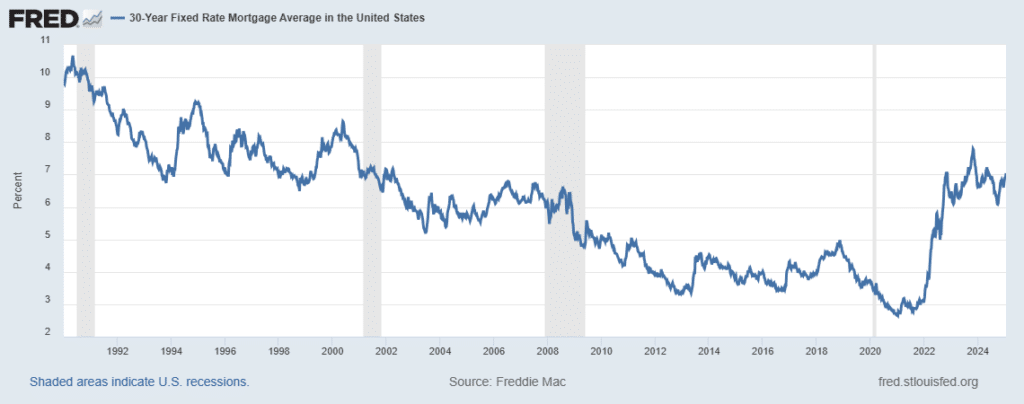
30 year Mortgage Rates Data Chart from Freddie Mac - 1990-2025


Putting Current Rates into Perspective

While mortgage rate drops haven’t matched the hype accompanying the Federal Reserve’s decision to start rate cuts last year, current rates have less to do with mortgage affordability than you might think. Those sub-3% mortgage rates many remember from 2021 were an exceptionally low anomaly – the result of aggressive intervention by the Federal Reserve during the COVID-19 pandemic, slashing the Fed Funds Rate to near zero to support and stabilize the economy.

Historically, mortgage rates in the range of 6-7% are much more representative of what we might consider “normal” market conditions. To put this into perspective, during the 1990s and early 2000s, mortgage rates routinely fluctuated between 5% and 8%. While today’s rates may seem high compared to pandemic-era lows, they are aligned with historical averages.

Current rates have a bigger effect on mortgage affordability simply because this “normal” rate environment follows on the heels of historically low mortgage rates, contributing to low housing inventory.

Inventory is Still Impacting Affordability

While mortgage rates have hogged the limelight on affordability, we can’t ignore the role limited inventory has played in keeping the housing market expensive. Many homeowners who refinanced their mortgages during the historically low 3% interest rate era are now opting to stay put, rather than sell and take on new loans at the higher rates available today. This “rate lock-in” effect has led to a stagnant housing supply, with fewer properties being listed for sale.

In an encouraging market shift, there was a notable uptick in active listings in November 2024—up 12.1% from one year prior. Over half of these homes, however, have been on the market for more than 60 days—often because they are overpriced or in less desirable condition. Despite the increase in new and existing homes being listed, the reality is that home prices do not appear to be dropping significantly any time soon.

Amid calls to build more homes to alleviate inventory shortages, market data suggests plenty of new construction listings are on the market. Rather than slashing prices to move more homes, many builders may opt to rent out homes rather than releasing more inventory. Coupled with a flood of investors paying cash and flipping properties to capitalize on pricing growth trends, these trends pressure home prices to remain high or rise further, even as demand cools due to higher rates.

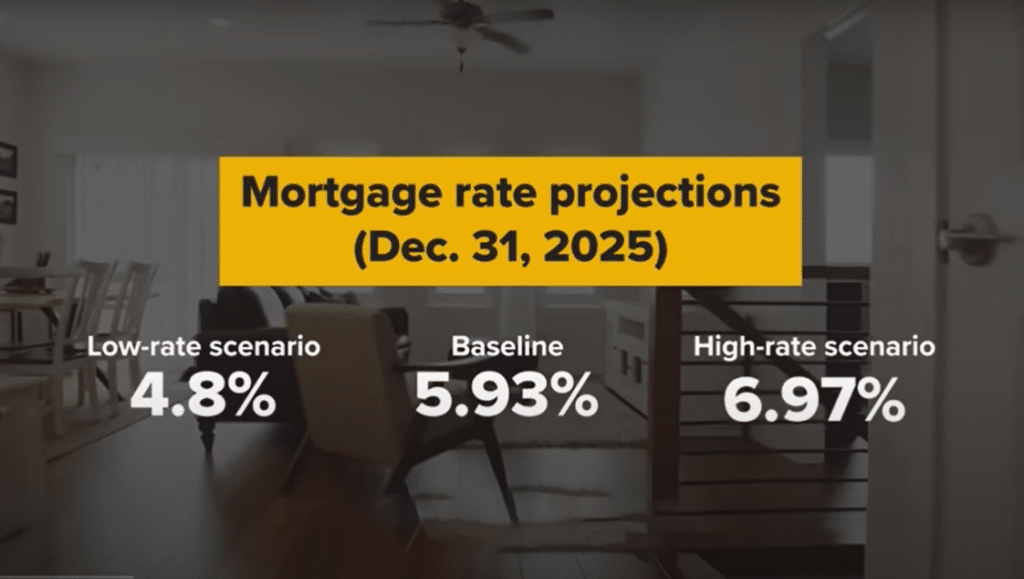
Graphic with a blurred image background. Title of the graphic, "Mortgage rate projections (Dec. 31, 2025)." Three blocks of text below the title list out the projections: "Low-rate scenario 4.8%", "Baseline 5.93%", and High-rate scenario 6.97%"

Image Source – CNBC Video “Why Fed rate cuts aren’t making mortgages cheaper”: https://www.cnbc.com/video/2024/12/21/why-fed-rate-cuts-arent-making-mortgages-cheaper

Looking Ahead to 2025

As we head into 2025, the Fed is expected to continue gradually cutting rates in an attempt to make housing more affordable, but mortgage rates may not follow suit. Expert forecasts indicate mortgage rates could remain above 5.5% throughout 2025, while others suggest rates are more likely to stabilize closer to 7-7.5% for 30-year fixed loans. As the housing market adjusts to this new reality, buyers are increasingly learning to adapt to what is now a “new normal” for mortgage rate after two years where mortgage rates averaged above 6%.

What Does This Mean for You?

If you’re planning to buy a home, it’s important to think long-term. While home prices may feel high now, home ownership remains one of the most stable and rewarding investments. Current mortgage rates are higher than they were during pandemic lows but are indicative of a normal housing market, and the “rate lock-in” effect making homeowners hesitant to sell has an expiration date.

While housing inventory is still limited, with builders and sellers holding out higher demand, we could see home prices go up from their current high. Pricing in the housing market generally increases over time and rarely adjusts down. By buying a home at current prices, you may benefit in the future as values continue to rise.

For current homeowners, exploring options to tap into your home’s equity could offer financial relief. Home Equity Lines of Credit (HELOCs) can allow you to access funds for renovations while keeping your existing mortgage rate. Leveraging a Cash Out Refinance to consolidate debt could potentially offer relief by saving you money on monthly debt payments.

Navigating the Market with Confidence

As we transition into 2025, it is clear that the housing market continues to face challenges, but it still holds opportunities for informed, proactive buyers and homeowners. That’s why it’s essential to stay updated on economic indicators like 10-year bond yields, Federal Reserve policies, and housing inventory.

Whether you’re looking to buy, sell, or leverage your equity, a knowledgeable mortgage professional can guide you through the best timing and financing options to achieve your goals.

Homeowner’s Fall Maintenance Checklist: Prepare Your Home for the Colder Months Ahead
Read more...
August Market Insights: The Big Change Coming to Real Estate for Home Sellers
Read more...

Understanding Closing Costs: A Homebuyer’s Guide

Understanding Closing Costs: A Homebuyer’s Guide 4500 3000 Your Loan Officer for Life

Key Takeaways

  • Closing Costs Demystified: Learn exactly what closing costs entail, including lender fees, title and escrow charges, and prepaid expenses, giving you a clear picture of what to expect when finalizing your home purchase.
  • Strategies to Minimize Expenses: Discover actionable strategies and insider tips on how to potentially reduce your closing costs, from negotiating with the seller to shopping around for services and exploring lender credits.
  • Preparation Is Key: Understand the importance of budgeting for closing costs early in the homebuying process and how being prepared can save you from unexpected financial strain, ensuring a smoother transition to homeownership.

Buying a home is a milestone filled with excitement and anticipation. But beyond the search for your dream home lies the often-overlooked world of closing costs. These expenses can be a bit of a puzzle, but worry not! I’m here to guide you through this final stretch of your homebuying journey, ensuring you cross the finish line informed and ready. Let’s dive into what closing costs are, why they matter, and how you can prepare for them.

What Are Closing Costs?

Closing costs are the fees and expenses you pay to finalize your mortgage, beyond the down payment. They cover a range of services involved in the legal transfer of property and securing your loan. Think of them as the backstage crew that makes the show—your home purchase—happen. Typically, closing costs range from 2% to 5% of the home’s purchase price, a spectrum that highlights the importance of budgeting for these costs early on.

Key Players in Closing Costs

  1. Lender Fees: These are fees charged by your mortgage lender for processing and approving your loan. They can include application fees, origination fees, processing fees, and underwriting fees.
  2. Title and Escrow Charges: To ensure the property is legally transferred to you without any claims or liens, you’ll encounter title search fees, title insurance, and escrow fees.
  3. Prepaid Expenses: These are upfront costs for items paid in advance of their due date, such as property taxes, homeowners insurance, and interest that will accrue before your first mortgage payment.
  4. Third-Party Fees: These fees are paid to other parties involved in your home purchase, like appraisals, home inspections, credit reports, and attorney fees.
  5. Government Recording and Transfer Charges: Buying a home involves some paperwork at the government level, including recording fees and transfer taxes.

Why Do Closing Costs Matter?

Understanding and budgeting for closing costs are crucial steps in the home buying process. They can significantly impact the total amount you’ll need to bring to the closing table. Overlooking these costs can lead to surprises and financial strain, something we all want to avoid, especially during such a monumental life event.

How to Prepare for Closing Costs

  1. Research and Budget Early: Start by getting an estimate of what your closing costs might be early in the home buying process. Use online calculators, but remember, these are just estimates. Your lender will provide a more accurate figure with the Loan Estimate after you apply for a mortgage.
  2. Shop Around: You have the right to shop around for certain services listed on your Loan Estimate, such as title insurance and home inspections. Comparing prices can save you a significant amount of money.
  3. Negotiate with the Seller: In some markets, it’s possible to negotiate with the seller to cover some or all of your closing costs. This can be part of your offer or a negotiation point after the inspection.
  4. Look for Lender Credits: Some lenders offer credits to help offset closing costs in exchange for a higher interest rate on your loan. This can be a worthwhile trade-off, depending on your financial situation and how long you plan to stay in the home.
  5. Set Aside Savings: As you save for your down payment, also set aside funds for closing costs. Having a specific savings account for this purpose can help you track your progress and ensure you’re ready when closing day arrives.

Closing Cost Assistance Programs

For many, saving for both a down payment and closing costs can be daunting. Thankfully, there are assistance programs available to help:

  • State and Local Programs: Many states, counties, and cities offer grants or loans to help with down payments and closing costs. These programs often have income limits and other eligibility requirements.
  • Lender-Specific Programs: Some lenders offer programs designed to help with closing costs, especially for first-time homebuyers or low-to-moderate-income individuals.
  • Nonprofit Organizations: There are also nonprofit organizations that offer assistance with down payments and closing costs for qualified buyers.

Closing Day: What to Expect

When closing day finally arrives, you’ll sign a lot of paperwork, but it’s the moment you officially become a homeowner. You’ll pay your closing costs, which can be done via cashier’s check or wire transfer. Once all documents are signed and funds are distributed, the keys to your new home will be yours!

The Power of Knowledge

As with any significant financial decision, knowledge is power. Understanding closing costs empowers you to budget effectively, negotiate confidently, and navigate the homebuying process with a clear vision. Remember, every homebuyer’s journey is unique, and there are resources and professionals ready to support you along the way.

Join Our Community for More Insights

Embarking on your homebuying journey? Join our newsletter for monthly insights, tips, and real-life stories to guide you through home ownership, financial decisions, and beyond. Our community is here to support you in achieving your dreams, one step at a time.

In writing this guide, I aimed to demystify closing costs and highlight the importance of planning for these expenses. By understanding what to expect and how to prepare, you’re setting yourself up for a smoother homebuying experience. Remember, you’re not alone in this journey. Professionals, assistance programs, and communities like ours are here to support you every step of the way.

Sign up for our newsletter to stay informed and empowered as you navigate the path to home ownership. Together, we can turn the dream of owning a home into a reality.

Graph paper with "Savings Tracker" written in pencil at the top and rectangles in rows and columns across the page with savings goals in them.
Smart Home Buying: How to Harmonize Your Property Dreams with Financial Wellness
Read more...
Discover 2024’s Top Neighborhoods with Smart Financing Options
Read more...

Finding Your Perfect Mortgage Match: A Guide to Making the Right Choice

Finding Your Perfect Mortgage Match: A Guide to Making the Right Choice 1920 1280 Your Loan Officer for Life

Key Takeaways

  • Know Your Budget: Dive deep into your budget to ensure your mortgage payments fit comfortably alongside your other expenses and savings goals, ensuring a stress-free financial future for you and your family.
  • Explore Your Options: Mortgages aren’t one-size-fits-all. From fixed-rate to adjustable-rate, and even government-backed loans, exploring all your options helps you find a mortgage that aligns perfectly with your financial situation and future plans.
  • Guidance is Golden: Navigating the mortgage landscape can be daunting, but you don’t have to do it alone. Seek expert advice and guidance to demystify the process, making your journey as smooth as possible.

Even if you’re a pro at the mortgage process, loan options are constantly changing! So are your lifestyle and financial goals. The right fit for a couple buying a fixer-upper with good bones probably isn’t the perfect match for a growing family looking for a big backyard.

Whatever your stage of life, choosing a mortgage is one of those big decisions, right up there with deciding on a career path or choosing the right school for your kids. It’s not just about the here and now; it’s about setting up a foundation for your and your family’s future. So, let’s dive into how you can find your perfect mortgage match.

Assessing Your Financial Health

Before you start swiping right on potential mortgages, it’s crucial to get personal with your budget. What can you comfortably afford each month without stretching yourself too thin? It’s not just the mortgage payment; factor in property taxes, insurance, maintenance, and those little surprises life loves to throw at us. Take a breath to assess your financial health. You want a loan you can breathe in with room to grow into.

  • Credit Score: This is your financial report card. A higher score can open doors to better rates.
  • Debt-to-Income Ratio: Lenders love this one. It’s all about how much debt you have compared to your income.
  • Down Payment: Think of this as your commitment level. A higher down payment usually means better terms.
  • Employment History: Lenders want stability, so a steady job history is a plus. Self-employed borrowers need a lender like Milend that offers loan programs that accept bank statements and 1099s as documentation of income.

Understanding Mortgage Basics

First things first, let’s break down the basics. A mortgage isn’t just a loan; it’s a commitment. It’s about finding a balance between your current financial situation and your dreams for the future. Think of it as a long-term relationship with your bank or lender. There are loans you can live with and loans you can fall in love with! Here are the main types:

  • Fixed-Rate Mortgages: Classic and predictable. Your interest rate stays the same throughout the loan term, which means your monthly payments won’t change. Great for those who like stability and long-term planning.
  • Adjustable-Rate Mortgages (ARMs): ARMs are appealing because they often offer a lower entry interest rate, but that rate could change over time. The interest rate adjusts at predetermined intervals, which means your payments could go up or down. Ideal for those who plan to move or refinance in a few years.
  • Government-Backed Loans: These include special loans, like FHA, VA, and USDA loans, that offer benefits like lower down payments or no down payment at all for eligible borrowers.

Consider the Loan Term

The loan term is how long you have to pay back your mortgage. Common terms are 15 and 30 years, but there are other options too. Shorter terms usually mean higher monthly payments but less interest paid over time. Longer terms lower your monthly payments but increase the total interest paid.

Think about what stage of life you’re in and what your financial goals are. When we were considering our mortgage, we opted for a longer term to keep our monthly payments manageable, giving us more flexibility for family vacations and saving for college.

Pay Attention to the APR

The Annual Percentage Rate (APR) is like the true cost of the loan, including the interest rate, points, fees, and other charges. Comparing APRs from different lenders can give you a clearer picture of which loan is more cost-effective in the long run.

Consider Your Down Payment

The down payment is a big deal—it affects your interest rate, loan terms, and whether you’ll need to pay for private mortgage insurance (PMI). A larger down payment can mean more favorable loan conditions, but it’s also important to keep enough cash on hand for emergencies and other financial goals.

Read the Fine Print

Before you sign on the dotted line, make sure you understand all the terms and conditions of your mortgage. Look out for prepayment penalties, balloon payments, and any other clauses that could affect your financial future.

Think About the Future

Life is full of changes—career shifts, growing families, and unexpected twists and turns. Consider how flexible your mortgage needs to be to accommodate future life changes. Can you make extra payments without penalties? Is refinancing an option down the line?

Wrapping Up

At Milend, we’re here to guide you through every step of the process, from initial questions to closing day and beyond. Because when you succeed, we all succeed. Let’s make those home dreams a reality together!

We hope this guide helps illuminate the path to finding your ideal mortgage. It’s all about understanding your own needs, doing your homework, and making informed decisions. And remember, we’re always here to lend a hand or answer any questions you might have. After all, we’re in this journey together—towards a future that’s as bright and promising as your dreams.

Discover 2024’s Top Neighborhoods with Smart Financing Options
Read more...
Navigating the Home Loan Process: Your Friendly Step-by-Step Guide
Read more...