

Key takeaways
- Using a home equity line of credit (HELOC) or home equity loan to pay off credit cards can mean paying a lot less interest and keeping track of one payment instead of several.
- Your first mortgage stays exactly as it is, so a low rate you locked in a few years ago doesn’t have to change.
- Paying off cards with equity moves that balance onto your home. A plan to pay it down is what makes it work.
- The biggest risk isn’t the loan, it’s the cards. Paying them off only helps if they stay paid off.
- Balance transfers, personal loans and a cash-out refinance all have a place, depending on how much you owe and what your current mortgage rate is.
If your credit card balances have barely moved even though you pay every month, you’re far from alone right now. With how expensive everything is these days, it doesn’t take an emergency to run the cards up, just a few months of groceries, gas and everyday costs running ahead of the paycheck. The minimums get paid, nobody misses a due date, and somehow the totals stay right where they were.
If you own your home and you’ve built up equity, you have an option a lot of people with card debt don’t. Using that equity to pay the cards off can mean paying far less interest and keeping track of one payment instead of several. It works best with a clear plan, so I want to walk through how it works, what else is out there, and how to make it stick.
Why card balances are so hard to pay down
Credit cards carry some of the highest interest rates of any kind of borrowing. When you only make the minimum payment, a big share of it goes to interest, and only what’s left chips away at the balance itself. That’s why a balance can sit there for years even when you’re paying every month like clockwork.
Nothing is backing a credit card, so the card company charges more to cover its risk. Your home is different. A loan backed by your home is less risky for the lender, and that’s the main reason the interest on home equity borrowing usually runs much lower than what the cards charge.
Carrying a card balance isn’t a sign that someone did something wrong. It’s simply how the math on high-interest balances works, and it’s the reason moving those balances somewhere cheaper can make such a difference.
How paying off cards with home equity works
The idea is simple. You open a second loan against your home, use it to pay the credit cards off in full, and then make one payment to one lender instead of several payments to several card companies. Because your home backs that second loan, the rate is usually a lot lower than the cards, so more of each payment goes toward the balance instead of interest.
Your first mortgage doesn’t change at all. A second loan sits alongside it, so if you locked in a low rate on your mortgage a few years ago, that rate stays right where it is. For a lot of homeowners right now, that’s the whole reason to use equity this way instead of refinancing.
There are two ways to do it:
- A home equity line of credit (HELOC) works a lot like a credit card limit backed by your home. You draw what you need to pay off the cards, and you only pay interest on what you’ve used. It’s flexible, and the rate on most HELOCs can change over time.
- A home equity loan gives you one lump sum with a set payment and a set payoff schedule. If you know exactly what you owe and you want a payment that won’t change, this one is often the better fit.
Your loan officer can look at your balances and your equity together and tell you which one fits the plan.
The part to understand before you borrow
Paying off credit cards or other loans with home equity moves that balance onto your home, so your house is backing it now. That’s a real change from a credit card, where nothing is attached to the balance. It’s also why making the payments on time matters even more than it did with the cards.
Paying it off can also take longer. A home equity loan or line usually gives you more time to repay than a credit card does, which is part of why the monthly payment can feel so much lighter. If you stretch it out and only make small payments, though, you can end up paying for those old card balances for a lot longer than you’d planned.
Those trade-offs aren’t a reason to avoid using equity. They’re the reason to go in with a plan, and that plan is what separates the people this works well for from the people who end up right back where they started.
Your other options, side by side
Home equity isn’t the only way to get ahead of card debt, and it’s not always the right one. Here’s how the common options compare.
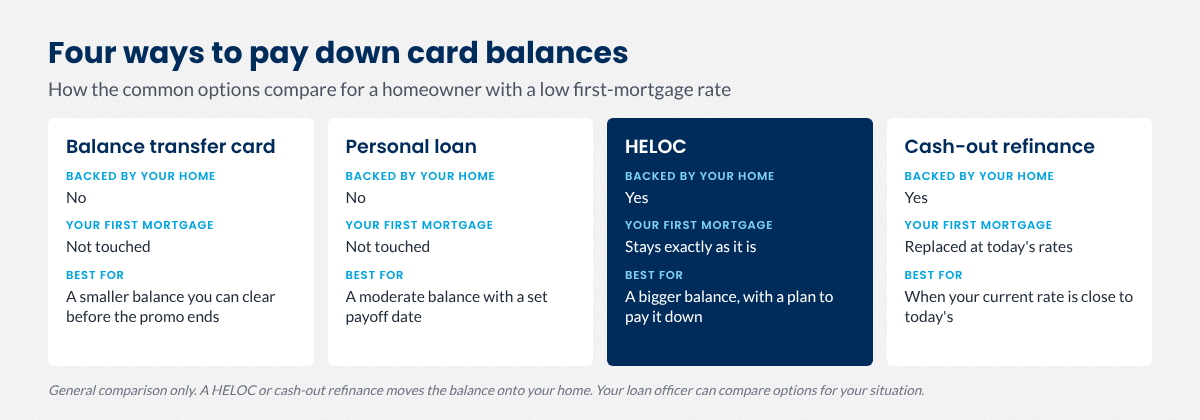
A balance transfer card. You move a balance to a new card with a low promotional rate for a set stretch of time. It can work well for a smaller balance you’re confident you can pay off before that promotional period ends. After it ends, the card’s regular rate applies to whatever’s left, and most cards charge a fee to transfer the balance in the first place.
A personal loan. A personal loan isn’t tied to your home, which some people prefer, and it comes with a set payment and payoff date. Because nothing is backing it, the interest usually runs higher than borrowing against your home. For a moderate balance with no equity to use, it’s a reasonable middle ground.
Nonprofit credit counseling. If the payments themselves have become hard to make, a nonprofit credit counseling agency can help you build a budget and may be able to set up a repayment plan with your card companies. It’s a good place to start when the problem is the monthly budget more than the interest rate.
A HELOC or home equity loan. This is the option that usually means the least interest for a bigger balance, and it leaves your first mortgage alone. It works best for homeowners with steady income, real equity and a plan to keep the cards paid off.
A cash-out refinance. This replaces your whole mortgage with a new, bigger one and uses the extra to pay off the cards. It makes sense when your current mortgage rate is close to today’s rates, or when you’d rather have one loan and one payment. If your current rate is a lot lower than today’s, moving your entire mortgage balance to a higher rate to pay off a much smaller card balance usually costs more over time. You can read more about keeping your first mortgage and still using your equity.
A payoff plan that sticks
The loan is the easy part. The plan is what decides whether you come out ahead, so I’d walk through these five steps before you borrow a dollar.
1. List everything you owe. Every card and every loan, with the balance, the interest rate and the minimum payment. Seeing it all on one page is usually eye-opening, and it’s the first thing your loan officer will want to look at with you. 2. Decide what to pay off. Most people start with the highest-rate balances, since that’s where the interest hurts most. A car loan or other loan that already has a low rate may not belong in the plan at all. 3. Pick a payoff date and put it on autopay. Choose a monthly amount that pays the new balance down by a date you’re comfortable with, not just the smallest payment allowed. Setting it up on autopay takes the decision off your plate every month. 4. Decide what happens to the cards. This is the step that makes or breaks the whole thing. Some people keep one card for emergencies and put the rest away where they won’t be tempted. Talk with your loan officer before you close any accounts, since closing them can affect your credit. 5. Build a small cushion. Even a modest amount in savings means the next car repair or surprise bill doesn’t land right back on a card. It’s the piece that keeps the cycle from starting over.
A note about taxes
Interest on home equity borrowing used to pay off credit cards or other personal debt generally isn’t tax-deductible. The deduction rules for home equity interest are tied to using the money to buy, build or substantially improve the home, and limits apply. Check with your tax professional about your own situation before you count on anything either way.
Questions I get asked
Will this hurt my credit? Applying involves a credit check, and your loan officer can tell you exactly what kind before anything happens. How your score moves afterward depends on a lot of things, including how much of your card limits you’re using once they’re paid off and whether every payment lands on time. I can’t promise anyone a number, and you should be wary of anyone who does.
Should I include my car loan? It depends on the rate. If your car loan already has a low rate, paying it off with home equity may not save you much and puts the car payment on your house. If it carries a high rate, it can make sense to include it, and your loan officer can run it both ways for you.
What if I’ve done this before and the cards crept back up? It happens more than people admit, and it’s exactly why the plan matters more than the loan. If that’s your history, be upfront about it with your loan officer. A home equity loan with a set payoff date, plus a real decision about what happens to the cards, can make the second time stick.
Do I have to refinance my mortgage to do this? No. A HELOC or home equity loan sits alongside the mortgage you already have, so your first mortgage, its rate and its payment don’t change.
How much equity do I need? Lenders usually cap how much you can borrow against your home in total, counting your mortgage and the new loan together. Your loan officer can tell you what that looks like for your home, or you can get a rough idea with our Equity Explorer.
Where to start
If the card balances have been sitting there longer than you’d like, start by putting everything on one page, then give me a call and we’ll look at it together. You’ll know within one conversation whether home equity makes sense for your situation, and if it doesn’t, I’ll tell you what would. You can also reach us through our contact page or at (855) 645-3631.
This page is general information, not a commitment to lend or an offer of credit. Loans are subject to credit approval, and what you may qualify for depends on your credit, income, home value and current mortgage.