
Key takeaways
- Fall is the worst season for routine pruning, because a pruning cut is an injury and a tree heading into winter is not growing the tissue it uses to close one.
- Fall is the best season for planting in Georgia, because the soil stays warm enough to support root growth through much of the winter.
- The tree job that does belong to October is a slow walk around the yard, since the weeks when leaves are coming down are the only time you can see the shape of a tree clearly.
- Homeowners insurance covers a tree that hits your house or another insured building, and generally does not cover hauling away one that falls in the yard and hits nothing.
- Roughly three-quarters of Atlanta’s tree cover stands on single-family residential land, so most of this city’s trees are private property and somebody’s responsibility.
A client called me in October last year about a tree. Not a mortgage question, a tree question. A big water oak had come down across his driveway during a storm, and he wanted to know whether there was a smart way to pay for the removal, because his insurance company had told him something he did not expect and he was still absorbing it.
I get more of these calls than you might think. People call their loan officer when a number lands on them out of nowhere, and a mature tree failing next to a house is one of the larger numbers a homeowner meets without warning. That conversation sent me down a long road of reading about tree care, and what I found surprised me enough that I have been repeating it to clients ever since. Almost everything most of us do with our trees in the fall, we are doing in the wrong season.
The season everybody prunes is the season arborists tell you to wait
Autumn feels like the time to cut things back. The leaves come off, the yard looks unkempt, the weather is finally pleasant to work in, and tidying up seems like the responsible thing to do before winter arrives. It is one of the most common instincts in homeownership, and horticulturists spend a good part of every autumn talking people out of it.
The reason comes down to what a pruning cut actually is. Kansas State University’s extension service puts it plainly: pruning, although a recommended practice, creates an injury. The question is never whether to prune, it is when to prune so the tree can deal with the wound as quickly as possible. Fall is not that moment, because the plant is shutting down for the winter and is not focused on producing the new tissue that protects the cut. Late winter and early spring, when growth is fastest, is when the tree is best equipped to handle it.
There is a second reason, and it changed how I look at trees. Trees do not heal the way we do. When you cut yourself, the wound scabs, new skin grows in, and eventually the injury is gone. A tree cannot do that. Instead it seals, walling the damaged wood off behind a layer of cells and growing new wood over the top. Arborists call this compartmentalization. The damage is still in there permanently, covered over. If you cut into that trunk years later you can still see exactly where the old wound was.
Timing is what decides which of those two outcomes you get. A cut made when a tree can seal it quickly becomes a small sealed pocket. A cut made when the tree is shutting down for the year sits open longer, and if the tree cannot get ahead of it, that is where rot begins. Decay builds cavities, and cavities are what eventually cause a large limb or a whole trunk to fail years down the line, often in a storm, often over something expensive.
None of this means you should never touch a tree in autumn. Extension guidance is clear that removing dead, dying, broken or hazardous limbs can be done at any time of year, because the safety of people and property comes first. If a branch is hanging over your driveway right now, deal with it now. What should wait is the discretionary work: the shaping, the thinning, the general tidy-up that is about how the tree looks rather than whether it is dangerous.
Fall is the right time to plant, and Georgia’s soil is the reason
Planting is where the calendar turns around completely. The season that is wrong for cutting is the best one of the whole year for putting a tree in the ground, and in Georgia the advantage is bigger than it is in most of the country.
University of Georgia Extension has been making this case for years. Most people plant in spring, because spring is when garden centers are full and planting feels seasonal, but a tree planted in fall gets to build an extensive root system while the top of the plant is dormant and demanding nothing. Frank Watson, a UGA Extension coordinator, points out that soil temperature across most of the state stays warm enough to support root growth during most or all of the winter. The tree is not sitting idle for four months. It is building the thing it will need most.
The payoff arrives in July. A tree planted this October goes into next summer with roots already established and ready to pull water. A tree planted next April goes into the same summer with almost nothing underground, trying to keep a full canopy of leaves supplied during the hottest, driest stretch of a Georgia year. UGA’s position is that a correctly sited and planted fall tree will simply outperform a spring one, and the reason is that head start.
A few things matter if you plant this autumn. Check the trunk before you buy, because any damage to the bark is reason enough to leave that tree at the nursery. Look for a straight trunk and an even, balanced canopy, which will be easier to shape later and tends to be structurally sounder. Check the container for roots circling the inside, which is a sign the tree has been in the pot too long and will have a poor root system once it goes in the ground. Dig the hole two to three times the width of the root ball, set the tree at the same depth it was growing at, and leave the fertilizer until spring so the roots establish before you push new growth up top. New trees need extra water for their first two years, which is the step most people abandon somewhere in year one.
Think about placement as though the tree is already full grown, because one day it will be. The Insurance Information Institute, drawing on restoration specialists, suggests keeping large shade trees at least twelve feet from structures that roots could damage, and offers a general rule of not planting trees within twenty feet of the house. Roots rarely attack a foundation directly. What they do is shift and dry the soil underneath and around it, and unstable soil is what moves a foundation.
Most of Atlanta’s trees are standing in somebody’s yard
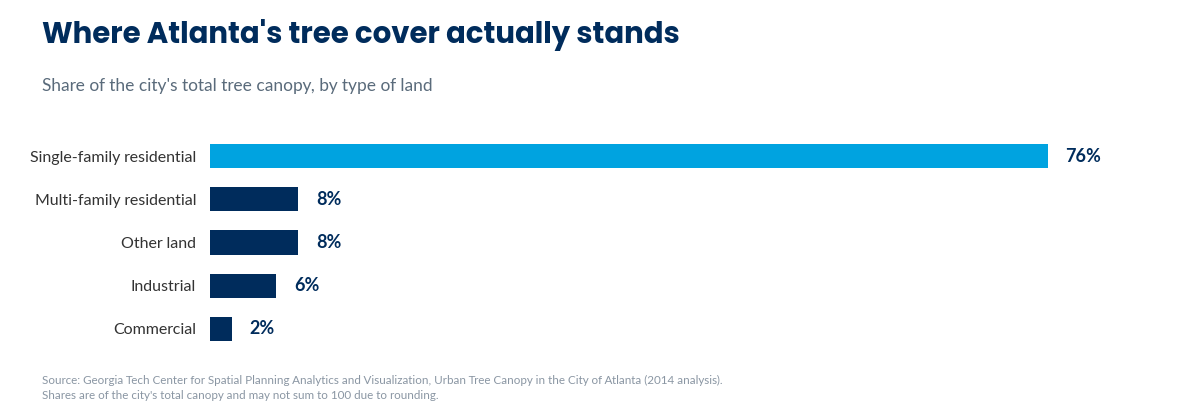
We talk about Atlanta’s tree cover as though it belongs to the city, and legally almost none of it does. Georgia Tech’s canopy analysis for the City of Atlanta found that single-family residential land accounts for about three-quarters of the city’s entire tree canopy. Parks hold around five percent. The rest is scattered across multi-family, industrial and commercial land.
Private ownership of those trees reframes the whole subject. When people say Atlanta is a city in a forest, the forest they are describing is mostly in back gardens, along driveways and over roofs, and it is maintained, or not maintained, by individual homeowners one property at a time. If a large tree near your house is in poor shape, there is no city department that is going to notice.
Atlanta’s tree cover has been thinning, too. The most recent assessment from Georgia Tech, released in August 2026, put the city’s tree cover at 45.7 percent of total land area in 2023, down from 46.5 percent five years earlier, and found the city has lost an average of close to 150 acres of urban forest a year since 2008. Most of that recent loss came from development rather than from individual homeowners cutting trees down. Still, it means the trees standing in private yards are carrying more of the load than they used to.
What to look at when you walk the yard
Walking the yard is the job that belongs to October, and it costs nothing but half an hour. Once the leaves start coming down, you can see the architecture of a tree for the first time since April: the branch structure, the dead wood hiding in the middle of the tree, the shape of the trunk. In July it is all hidden behind foliage.
Professional arborists use a structured process for this, and the categories they work through are useful even for an untrained eye. The International Society of Arboriculture’s basic risk assessment walks an assessor through the crown, the branches, the trunk, and the root collar and soil, and then asks the question that most homeowners skip entirely: what is underneath. That last question is the one that matters most. A leaning, hollow tree in the middle of an empty field is a tree. The same tree twenty feet from a bedroom is a problem.
Start by standing back far enough to see the whole tree at once, then work down. In the upper part of the tree, you are looking for dead branches, broken or hanging limbs still caught up there, and whether the leaves this year came in noticeably thinner or smaller than on similar trees nearby. Significant dead wood up top is a sign of a tree in decline, not just an untidy one.
On the branches themselves, look for places where two limbs of similar size join, especially where the bark looks pinched into the union rather than flowing around it. Those unions are weaker than they look and are a common failure point. Look for cracks, and for evidence that a branch has already broken off at some point, which tells you the tree has a habit.
On the trunk, the things to note are a lean, cracks running up and down the wood, missing or dead bark, and open cavities. Mushrooms or hard shelf-like growths on the trunk are the clearest signal of all, because those are the fruiting bodies of fungi that live on decaying wood and are considered definite indicators of decay inside. If you see them on the trunk or at the base of a tree near your house, that is the point to stop guessing and call somebody.
At the base, look at the soil. Cracked or heaved soil on one side of the trunk means the tree has been moving in the wind more than it should. Look for whether the flare at the bottom of the trunk is visible at all, or whether soil, mulch or a new patio has been piled up against it. Check whether anything has changed near the tree in the past few years, such as a trench for a utility line, a grade change, a new driveway, or the removal of neighboring trees that used to shelter this one from wind.
What insurance does, and what it does not
Insurance is the part that caught my client out, and it catches out most people. Almost everyone assumes a homeowners policy treats a fallen tree as a fallen tree, and it does not.
According to the Insurance Information Institute, if a tree hits your home or another insured structure such as a detached garage, a standard homeowners policy covers the damage to the structure and the contents inside it, including trees brought down by wind, hail, or the weight of ice or snow. It does not matter whose property the tree was growing on. If it lands on your house, you file with your own insurer.
If the tree hits an insured structure, the policy also contributes toward removing it, but that contribution is capped and it is not designed to cover the full cost of taking down and hauling away a mature hardwood. And if the tree falls without hitting a structure, there is generally no coverage for removal at all. A large oak lying across your back yard, having touched nothing, is typically yours to deal with, though some insurers make an exception when the tree is blocking a driveway or an accessibility ramp.
Maintenance matters too. The Institute notes that where a neighbor’s tree falls on your house, your insurer may pursue their insurer if negligence can be shown, such as a tree that was diseased or was not properly maintained. That runs both directions. A tree you knew was failing and did nothing about is a different conversation with an insurance company than a healthy tree taken down by a storm.
I am not an insurance agent and your policy is the only thing that actually governs your situation. The useful move is to look up your own tree and debris removal limits before you need them, rather than during the week you need them.
More tree cover is not automatically more value
One last thing about value, because it surprised me. Trees are good for a property’s value, but the relationship is not a straight line, and cutting a healthy tree down is not automatically a loss.
A US Forest Service meta-analysis pooled twenty-one separate studies of tree cover and home prices, and found that the value effect appears to peak at somewhere around thirty percent tree cover on the property itself. The authors also noted that the typical study property had only about fourteen percent cover, which suggests most American homeowners have fewer trees than the market would reward, not more.
So if you are weighing whether a particular tree earns its place, you are asking a fair question, and the answer is not always yes. A well-placed, healthy, well-shaped tree near the house is doing real work for the property. A struggling one leaning over the roof is not paying you anything, and it is the one that will eventually send somebody a bill.
Your fall walkaround
Print this, or just keep it on your phone. Give it half an hour on a Saturday once the leaves are properly coming down, and work through one tree at a time rather than trying to take in the whole yard at once.
- ☐ Stand back far enough to see each large tree whole, and start with the ones closest to the house, the driveway and where people sit.
- ☐ Note what is underneath each tree within a distance equal to its own height, because that is what it can reach if it fails.
- ☐ Look for dead branches high in the tree, and anything broken or hanging that is still caught up there.
- ☐ Check where two limbs of similar size meet, looking for bark pinched into the join rather than flowing around it.
- ☐ Look up and down the trunk for cracks, missing or dead bark, and open cavities.
- ☐ Look for mushrooms or hard shelf-like growths on the trunk or at the base, which are a sign of decay inside.
- ☐ Check the soil at the base for cracking or heaving on one side, and make sure the flare at the bottom of the trunk is not buried.
- ☐ Note any change near the tree in the last few years: trenching, a grade change, new paving, or neighboring trees removed.
- ☐ Book a certified arborist for anything with mushrooms on it, a new lean, or a large limb over a room somebody sleeps in.
- ☐ Save the discretionary pruning for late winter, and put anything you want to plant in the ground this autumn instead.
If the walk turns up something that is going to cost real money, I would rather you called me early than late. A tree is not a mortgage question, but how you cover a large unplanned bill often is, and the options are better before the work is booked than after the invoice arrives.