

Homeowner Guides

Warm lamp-lit shelving unit with plants and books in a living room after dark

The Fall Lighting Fix: What to Change, Room by Room

The Fall Lighting Fix: What to Change, Room by Room 1200 630 Creative Studio

Key takeaways

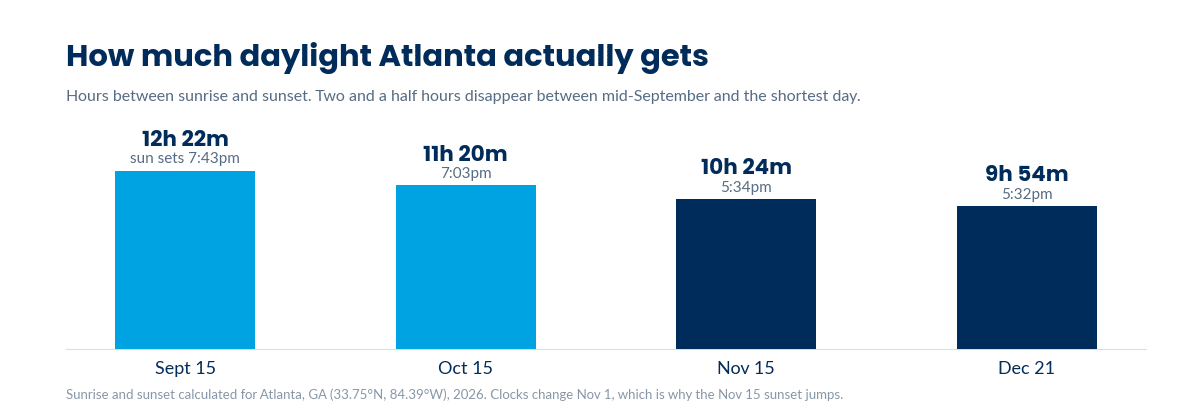
  • Atlanta loses about two and a half hours of daylight between mid-September and the shortest day in December, and the clock change on November 1st moves sunset an hour earlier overnight.
  • A room that feels wrong in winter usually has a lighting problem rather than a paint or furniture problem.
  • Designers treat the ceiling as one layer of three, not as the whole plan. Most rooms want light at three different heights.
  • The useful numbers on a bulb box are lumens for brightness and the Kelvin rating for warmth. Watts tell you almost nothing now.
  • Dimmers and LEDs have to be matched deliberately. The bulb has to be marked dimmable and the dimmer has to be rated for LED.

Every year around the first week of November, I start hearing the same thing from clients. The house feels dark. The living room feels smaller than it did in August. Somebody is thinking about repainting, or replacing a sofa, or wondering whether the windows are the problem. Almost nobody says the word lighting, and lighting is almost always the answer.

It is the least glamorous fix in a house and one of the cheapest, which is probably why it gets skipped in favor of things that cost ten times as much and work less well. So before you spend money on the wrong thing this fall, here is what is actually happening and what to do about it.

The light in your house is about to change, and quickly

We talk about winter as though it arrives in December, but the daylight starts leaving in September and it goes faster than most people expect. In Atlanta, the middle of September gives you a little over twelve hours between sunrise and sunset. By the shortest day of the year that is down to under ten. The sunset itself moves even more sharply than the total, sliding from around a quarter to eight in the evening to just after half past five.

Bar chart showing daylight hours in Atlanta falling from 12 hours 22 minutes on September 15 to 9 hours 54 minutes on December 21

The single biggest jolt comes on November 1st, when the clocks change. On October 31st the sun sets at about a quarter to seven. The next evening it sets at a quarter to six. That is an hour of your evening gone overnight, and it is the week people start describing their house as dark, cramped or depressing without quite knowing why.

Nothing about the house changed. The light did. And the light is the part you can actually do something about.

The mistake designers see most often

Sophie Paterson, a London-based interior designer who has spent sixteen years on residential projects, writes that the most common lighting mistake she sees is people creating a symmetrical grid of spotlights across the ceiling. It looks balanced on a floor plan, she points out, but in real life we rarely look up at the ceiling. What matters is how light behaves at eye level, how it washes a wall, and whether it draws your attention to anything.

Most rooms in most houses were built with a single fixture in the middle of the ceiling, and that one fixture is asked to handle every situation the room ever faces. It has to fill the space, light whatever you are doing with your hands, and make the room somewhere you want to sit. Those are three different jobs, and one bulb overhead does the first adequately and the other two badly.

Designers describe the fix as lighting in layers, and the vocabulary is more useful than it sounds. Ambient light is the general fill, usually your ceiling fixture. Task light is aimed at what you are actually doing, so a lamp beside the reading chair, something under the kitchen cabinets, a proper light over a desk. Accent light has no job except to make the room feel good, like a small lamp on a shelf or a light behind a plant.

Paterson also makes a point that reframes the whole thing: good lighting is not about making a room bright enough, it is about creating focus and contrast. Your eye goes to the brightest thing in the room. If you want a space to feel longer, light the far end of it. If you want a corner to feel like somewhere to sit, light it low.

The reason a hotel room or a friend’s living room feels better than yours often comes down to nothing more than this. They have three or four light sources at different heights. You have one, twelve feet up, pointing down.

If you do only one thing this fall, add a second light source at eye level or below in the room where you spend your evenings. It is a bigger change than paint, and it takes twenty minutes.

What the numbers on the box actually mean

Bulb packaging got confusing when incandescent bulbs went away, and plenty of people are still buying by watts out of habit. Watts measure how much electricity a bulb draws, which mattered when every bulb was equally inefficient. Now it tells you almost nothing about how bright the thing will be.

The number you want is lumens, which measures actual brightness. The Department of Energy’s guidance is that if you’re replacing what used to be a 75-watt bulb, you’re looking for roughly 1,100 lumens, and you can get that from an LED drawing as little as nine watts. Every bulb sold in the United States has carried a Lighting Facts label since 2011, modeled on the nutrition labels on food, and brightness in lumens sits right at the top of it.

The second number is the Kelvin rating, and this is the one that decides whether a room feels warm or clinical. A lower Kelvin number gives the soft yellow light people associate with an old incandescent bulb. A higher number gives a whiter, bluer light that reads as daylight. Paterson’s studio uses 2700K as its default for most rooms, describing it as warm without being overly yellow, and advises keeping the temperature consistent within a single space because mixing tones in one room feels jarring.

That last point explains something that frustrates a lot of people. If your living room has a warm bulb in the lamp and a cool one in the ceiling, the room will never quite settle, and no amount of repainting will fix it. It also explains why paint colors look so different after dark. You didn’t choose the wrong color, you’re looking at it under a different light than the one you chose it in.

Lighting is about 15% of an average home’s electricity use, according to the Department of Energy, and LEDs use up to 90% less energy and last up to 25 times longer than the incandescent bulbs they replaced. Adding lamps to a room doesn’t carry the running cost it would have twenty years ago.

Before you buy a dimmer, check the bulb

This is the part that catches people out, and it is the one thing here I would check before spending anything. Dimmers and LED bulbs have to be matched on purpose, and two things have to line up. The bulb has to be marked dimmable on the box, because a lot of LEDs are not and were never designed to be. And the dimmer itself has to be rated for LED. Lutron, which makes most of the dimmers in American houses, is explicit about this: a dimmer rated only for incandescent or halogen can control only incandescent or halogen bulbs, while a dimmer rated for LED can handle those as well. That older dimmer in your hallway was very likely built for incandescent bulbs and predates LEDs entirely.

Even within the dimmable category, manufacturers only stand behind combinations they have tested. Lutron publishes a compatibility tool listing the specific bulbs it has tested against each of its dimmers, and tells customers that if a bulb is not on that list, they should ask the bulb manufacturer for a recommendation. Mismatched pairs tend to announce themselves through flicker, buzzing, a narrow dimming range that drops straight to off, or bulbs that fail well before the life printed on the box.

None of that is a reason to avoid dimmers. A room that can be bright at six and soft at nine is effectively two rooms, and dimmers are the upgrade people most often say they should have done sooner. Just buy the bulb and the dimmer as a pair rather than assuming the bulbs you already own will work.

Where the money actually goes

Lighting covers an unusually wide range of cost, and the cheap end does more than people assume. Swapping bulbs is the smallest possible spend and it’s where I’d start, because changing the Kelvin rating of the bulbs you already own costs the price of a multipack and changes how every room reads at night. Plug-in lamps are the next step up, and a floor lamp or two in the corners of a room is the most reliable fix for the one-fixture problem. Paterson makes the point that you don’t need a renovation to change a room’s lighting at all: freestanding uplighters behind a sofa or on either side of a fireplace do a great deal of work for very little money.

Dimmers sit in the middle, with the compatibility caveat above. Above that you’re into hardwired work: a new ceiling fixture, wall lights, or under-cabinet lighting in the kitchen. That’s where an electrician gets involved and where the numbers start climbing. If you’re going that far, get everything quoted together rather than one job at a time.

If you’re thinking about listing in the spring

Here is where this stops being decorating and starts mattering to your bottom line. Most people who plan to sell in spring start getting the house ready in February or March, which is exactly the wrong order. The work you do now is the work you get to live with and adjust before anyone photographs it. Lighting is the clearest example, because it changes how a house reads in photographs and it changes how it feels in an evening showing, and those are two different problems.

Listing photos are usually shot in good daylight, and mismatched bulb temperatures are much more obvious in a photograph than they are to your eye standing in the room. One warm lamp and one cool ceiling fixture in the same shot gives you an orange corner and a blue corner, and buyers read that as a house that has been neglected rather than a house with two different bulbs in it. Making the temperature consistent room by room costs almost nothing and is one of the few things you can fix in an afternoon.

Evening showings are the other half. From November through February, most weekday showings happen after dark, and a house with one ceiling fixture per room shows badly at six in the evening in a way it never does at noon. Hallways, stairs and entryways matter most here, because they are the first thing a buyer walks through and they are almost always the worst lit part of a house.

I want to be careful not to overpromise. Nobody can tell you that a set of lamps will raise your sale price, and any improvement that comes with a guaranteed return is being sold to you by someone who does not know that. What I can say is that it is cheap, it is quick, and it addresses the thing buyers actually notice on a winter evening.

If selling next year is on your mind at all, that is the conversation I would rather have now than in March. Most people who sell are buying something next, and the two decisions are connected in ways that are much easier to work through early. Give me a call and we can talk about what your timing actually looks like. There is nothing to sign and nothing to commit to.

Your room-by-room walkthrough

Go through the house one evening after dark, with the lights on the way you normally have them. Not during the day, and not with everything switched on. The point is to see the rooms the way you actually live in them, and the way a buyer would see them at a six o’clock showing in January.

  • ☐  Living room: count your light sources. If the answer is one, add a floor lamp in the darkest corner.
  • ☐  Every room: check the Kelvin number on your bulbs and make it consistent within each space.
  • ☐  Kitchen: stand at the counter where you chop. If your body throws a shadow onto the work surface, you need light under the cabinets.
  • ☐  Bedroom: make sure each side of the bed has its own light that can be switched off without getting up.
  • ☐  Hallways, stairs and entryway: almost always the worst lit space in a house, and the first thing a visitor walks through.
  • ☐  Home office or desk: add a dedicated task light rather than relying on the ceiling and the screen.
  • ☐  Any room you avoid in the evening: ask whether you avoid it because it’s cold, cluttered, or just badly lit.
  • ☐  Dimmers: confirm the bulbs are marked dimmable and the dimmer is rated for LED before you buy either.
  • ☐  Front entry and porch: dark by five in December, and the first thing guests and buyers see.
  • ☐  Make a list of anything needing an electrician and get it all quoted together.

Work down that list and most people find three or four fixes, none of them expensive, that change how the house feels for the four months it matters most. Start with the room where you spend your evenings, and start before the clocks change rather than after.

A living room mid-renovation with furniture under plastic dust sheets, taped moving boxes and an aluminium stepladder

Got the project list? There’s more than one way to pay for it

Got the project list? There’s more than one way to pay for it 1200 630 Your Loan Officer for Life

Key takeaways

  • Most homeowners decide how to pay for a renovation twice. Once before the first contractor arrives, and again mid-project when the budget runs over.
  • Think hard before a project takes your emergency fund with it. That’s one of the better reasons to borrow against the house instead.
  • The five ways of paying aren’t equal. You’ll pay far less interest on money borrowed against your home than on a credit card or a personal loan.
  • Refinancing isn’t the only way to reach your equity anymore, and for a lot of people it isn’t the obvious one.
  • A line of credit is a limit, not a lump sum. Size it for the project that runs over.

I was talking with someone recently who had spent three years saving for her kitchen. She had the number written down and she was proud of it, as she should have been. Then the work started, the old floor came up, and the number stopped being the number. That happens on most projects, and it’s the part almost nobody plans for.

Last week we went through which fall projects pay you back and which ones people regret. A lot of you wrote back with the same question, and it had nothing to do with garage doors. You wanted to know how to pay for it, so let’s talk that through. It’s the decision I watch people rush more than any other.

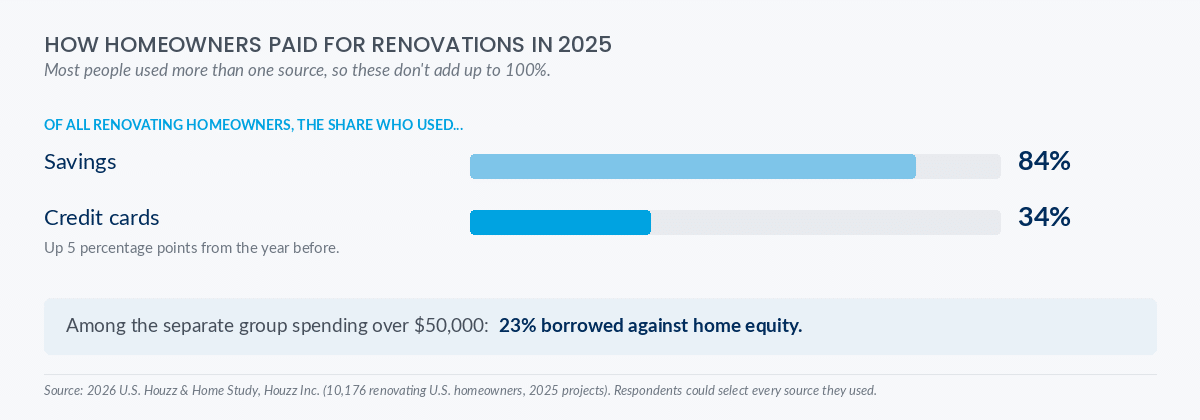
Bar chart of how homeowners paid for renovations in 2025: 84 percent used savings and 34 percent used credit cards, with a note that people could use more than one source. A separate callout says 23 percent of those spending over 50,000 dollars borrowed against home equity

The decision you make twice

Most people decide how they’ll pay for a renovation before getting a single estimate on the table. There’s a number in mind, and a plan for where it comes from. Then the tile is out of stock, or a wall comes down and something behind it needs attention, or the kitchen turns out so well that the hallway suddenly looks tired.

37% of homeowners spend past the budget they set, and most of them do it on purpose, choosing better materials or widening the scope once they can see the work taking shape. Those are usually good calls made for good reasons, but they do mean the money question gets asked twice.

The first decision happens at the kitchen table, with time to think it over. The second happens in week three, with a contractor standing in a half-finished room waiting on an answer. That second decision almost always costs more, not because the project changed, but because there was no time to think it through. That’s why I’d rather you had all of this before anyone quotes you, instead of after.

What people actually use

Most renovations get paid for out of savings, and there’s nothing wrong with that. It’s where I’d start too. What’s changed is how people cover the rest.

Credit cards now pay for part of the work on more than a third of projects, and that share climbs every year. Hardly anyone plans it that way. It happens partway through, when the money runs short and someone needs an answer the same day, and a credit card is the quickest thing in the wallet.

Most renovations get funded from more than one place, which is why the numbers in that chart add up past a hundred. Savings covers the bulk of it and something else covers the rest, and that something else is the part I’d want you choosing on purpose rather than by default.

The five ways people pay for it

These five ways of paying aren’t equal, and I’d rather say so plainly than pretend otherwise. Your own savings cost you no interest at all. Borrowing against your home costs some. A credit card or a personal loan costs the most, by a wide margin.

Savings. No lender, no paperwork, no lien on the house, and no interest to pay. Hard to beat when the money is sitting there.

The one thing I’d think about first is your emergency fund. That money already has a job. It covers a job loss, a failed water heater, a transmission. Spending it on a kitchen doesn’t make the next emergency any less likely, it just means you’ll be meeting that emergency with an empty account.

So if paying cash would clean you out, that’s a good reason to borrow against the house instead. You keep the cushion and the project still gets done.

A high-interest credit card. Fast, flexible, backed by nothing, and the most expensive way to pay for any of this. The speed is the whole appeal, and it’s also the trap.

The interest on a credit card buys you nothing. It doesn’t go into the house, it doesn’t come back at resale, and it isn’t building anything for your family. It leaves the account every month, and at credit card rates it leaves fast, which is why a credit card that started as a stopgap so often turns into the main thing you’re paying off.

There’s one narrow case where it works: something small you’ll clear in a couple of months, or a promotional rate you’ll pay off before it expires. Outside of that, a credit card becomes a bridge people end up living on, and I’ve had that conversation more times than I’d like.

A personal loan or contractor financing. Unsecured, so your house isn’t attached to it, and it’s usually quick. Nothing is backing it up though, so the interest runs much higher than a loan against your home, and you feel that difference every month for years.

Contractor-arranged financing is the one I’d read slowly, because the paperwork comes from the same people who want you to say yes to the bid. Ask who the lender actually is, and ask for the total cost over the full life of it in writing.

A home equity line or loan. On a bigger project, this is usually what we end up talking about. It’s a second loan that sits behind your existing mortgage and leaves that mortgage exactly as it is.

A line is at its best when the work happens in stages. You get a limit, you draw what you need as the job moves, and you only pay interest on what you’ve actually drawn. A loan is at its best when you already know the number: one defined job, one lump sum, one schedule.

What makes a home equity line or loan cheaper is straightforward. Your home is backing it, so the interest rate runs far below a credit card or a personal loan. On a renovation that takes a year or two to pay off, that difference adds up to real money.

A cash-out refinance. Sometimes the cheapest option depending on your scenario. You replace your existing mortgage with a larger one and take the difference, so everything stays on a single payment and a single schedule. It’s also the route that generally allows the largest loan-to-value.

The part that surprises people

For years there was one answer to “how do I get at the equity in my house,” and that answer was refinance. It’s still a good answer for plenty of families. It just isn’t the only one now, or even the usual one.

A lot of homeowners are sitting on a first mortgage they’d rather not touch. Companies who track this across most of the country, call it the lock-in effect. Earlier this year more than half of the equity homeowners took out came through second loans instead of refinancing, the strongest showing for second loans in almost twenty years. If you bought or refinanced between 2020 and 2022, there’s a fair chance I’m describing you.

Neither route wins by default. A refinance can be the cleaner move, especially if you’re not attached to your current mortgage or you’d rather keep everything in one place. What’s different now is that a second loan sits right beside it as a real choice, where a few years ago I’d have pointed almost everyone straight at refinancing. That’s what people get wrong on their own, and it’s what we can usually settle in one conversation.

Size the line for the project you’ll actually have

A home equity line of credit is a limit, not a lump sum. That makes choosing the size of the limit a separate decision from choosing how much to spend, and it’s the one I see homeowners size too small.

Set the limit against the project that runs over, not the one on the estimate. If there’s room in the line, week three costs you a phone call. If there isn’t, you’re applying for something in the middle of a build, and that’s where the expensive choices get made.

Ask me what affects the size of a line, and what fees come with keeping one open. Those vary, and they’re the part to understand before you settle on a number.

Using equity is simpler than people expect

A lot of homeowners put off calling a lender about their equity because they picture buying a house all over again, months of it, boxes of paper. Borrowing against a home you already own really isn’t that.

You already own the home. You already have the mortgage. The questions are about a property you know and a loan you’ve been paying on, and much of what I’ll ask for is paperwork already sitting in a drawer. That equity has been building the whole time your family has lived there, and putting a little of it back into the house is one of the most ordinary things a homeowner does with it.

Before you sign: a short checklist

Run through these questions before you sign a contractor’s contract, not after. Take them to whoever you’re talking to about money.

  • ☐  Write down your number, then add 20%. Plan for the version of this project that runs over, because that’s usually the one you get.
  • ☐  Decide now where the extra would come from. Make that second decision with time to think, instead of in week three.
  • ☐  Check what’s left in savings when the work is done. If the answer is “not much,” that’s an argument for using equity rather than emptying the account.
  • ☐  Ask whether this is one job or several. Staged work and a single defined job suit different options.
  • ☐  If a contractor offers financing, find out who the lender actually is. Get the total cost over the full life of it in writing first.
  • ☐  Ask whether your current mortgage is one you’d want to keep. For a lot of people it is, and that rules some options in and others out.
  • ☐  Ask what’s backing each option. Nothing backs a credit card or a personal loan, so they charge the most interest. Your home backs a refinance or a second loan, so they charge a lot less.
  • ☐  Ask what happens if the project stalls. There are answers for a delayed crew, a job that changes halfway through, and money released in stages. Get those answers before you need them.

Questions I get asked

Should I just put it on a credit card and pay it off fast? If fast really means a couple of months and you know the money’s there to do it, that can work. The trouble is that nearly everyone intends exactly that, and the balance tends to outlive the project by years. At credit card rates, that’s the most expensive version of this project there is.

Is it smarter to wait until I’ve saved the whole amount? It depends what the work is doing. A cosmetic refresh can wait, but anything holding back damage can’t, and waiting on that one usually costs more than using equity would have.

There’s also a cost to waiting that never shows up on paper. While you save, the project competes with everything else your savings is there for, prices don’t stand still, and if something gives out in the meantime it tends to land on a high-interest credit card anyway.

Can I use more than one of these? Yes, and most people do. Savings for the bulk of it, something else for the rest. The trouble starts when a high-interest credit card becomes the main source without anyone actually deciding it should.

Does it need to add value to be worth doing? No. Resale value is one way to judge a project, not the only one. Some of the best projects I’ve helped with were about living in the house rather than selling it. Just be clear with yourself about which one you’re doing.

Where to start

If you’re weighing something this fall, start with a conversation about which of these five fits your situation. It’s usually a short call, and it’s a good deal easier than most people expect. That’s the whole reason I put this together.

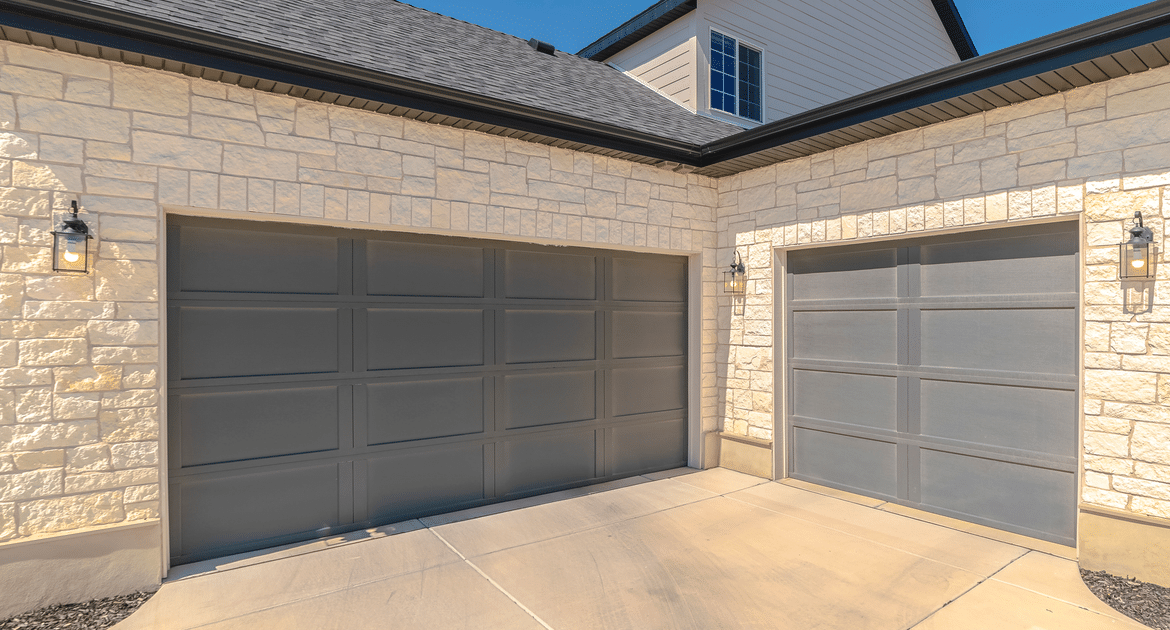
Two-car garage with stone facade and driveway

The 5 fall upgrades worth doing… and the 2 people regret

The 5 fall upgrades worth doing… and the 2 people regret 1200 630 Your Loan Officer for Life

Key takeaways

  • Eight of the top ten highest-returning projects this year are on the outside of the house.
  • A garage door replacement returns roughly 268% of its cost, the best of any project measured.
  • The only interior job in the top five is a minor kitchen refresh, not a full renovation.
  • Large additions and gut kitchens sit near the bottom. Wonderful to live in, poor at resale.
  • Exterior work pays you back when you sell. Interior work pays you back while you live there.

Most of us assume the money goes back into the house when we renovate. Some of it does. A lot of it doesn’t, and the difference isn’t where most people would guess.

Zonda’s Cost vs. Value report has been tracking this question for 38 years. It compares what a remodeling project costs against how much of that cost comes back in the sale price, using cost data from Verisk’s XactRemodel estimating platform and surveys of real estate professionals across 119 local markets. The newest edition, published in September 2025, found the same thing it found the year before, and the year before that… the projects that pay you back are almost all on the outside of the house.

Eight of the top ten are things a buyer sees before they ever walk through the front door.

That’s worth sitting with for a second, because it runs against almost everything we’re told. The kitchen and the primary suite get all the attention. They’re what people photograph, what they save to Pinterest, what they daydream about. They’re also, on average, where the least of your money comes back.

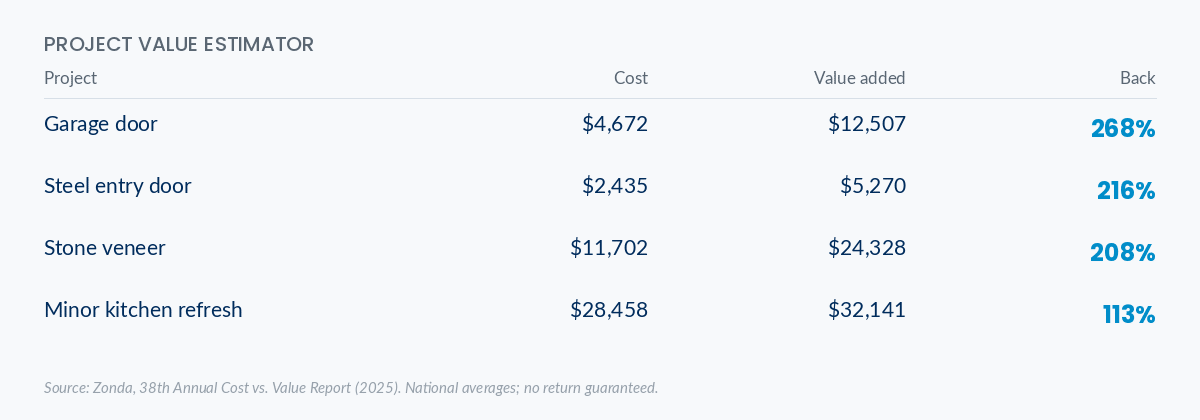
Project value estimator: garage door 268%, steel entry door 216%, stone veneer 208%, minor kitchen refresh 113% of cost recouped

What pays you back

1. Garage door replacement. First place, two years running, and it isn’t close. Average cost is $4,672 and it adds an average of $12,507 in resale value. That’s roughly 268% of what you put in.

It’s an odd winner until you think about how a house is actually seen. On most homes the garage door is the single largest visible surface from the street. A dented, faded, original-to-1998 door quietly ages the whole front of the house, and a new one quietly un-ages it. It’s a one-day job.

2. Steel entry door replacement. Second, at about 216%. Average cost $2,435, returning around $5,270. It’s the smallest job on the entire list.

A front door is the one part of the house every single visitor touches. If yours sticks, rattles, or has a draft you’ve stopped noticing, that’s the impression people are forming while they wait for you to open it.

3. Manufactured stone veneer. Third, at roughly 208%. Costs about $11,702 and adds about $24,328. This is usually a partial application, on a front facade or around an entry, rather than the whole house.

4. Fiber-cement siding replacement. About 114%. At roughly $21,485 it’s a considerably bigger job than the three above it, and it still returns more than it costs. It also solves maintenance problems rather than just cosmetic ones, which is worth something the report doesn’t measure.

5. Minor kitchen remodel. About 113%, at around $28,458. New cabinet fronts, new hardware, new counters, updated sink and fixtures. Crucially, this is not a tear-out. The layout stays. The plumbing stays.

It’s the only interior project in the entire top five, and it beats a full gut renovation by an enormous margin. If you’ve been putting off the kitchen because you assumed the only option was the expensive one, this is the finding worth knowing about.

What people tend to regret

Large additions and full kitchen gut renovations sit near the bottom of the same list.

That deserves a fair hearing, because “regret” is the wrong word if you’re staying put. A primary suite addition that gives your family another decade of comfortably living in a house you love is a good decision, whatever the resale math says. Zonda’s own editors make this point… large interior remodels are often too subjective to return the same value at resale, but they make the most sense for people planning to stay a long while.

The trouble is when people take on a big interior project expecting it to come back at closing. That’s where the disappointment lives. Not in the project. In the expectation attached to it.

The real split

Here’s the cleanest way to think about all of it.

Exterior projects pay you back when you sell. Interior projects pay you back while you live there.

Both are legitimate. They’re just not the same decision, and the honest first question is which one you’re actually making. If you’re planning to list in the next couple of years, the top of that list is where your money works hardest. If you’re planning to stay ten years and the kitchen makes you unhappy every single morning, fix the kitchen and stop reading ROI tables.

Why fall is the moment

Most of this work needs dry, moderate temperatures. Roofing, siding, exterior painting and deck work all depend on it, and once the weather turns you’re into freeze-thaw season when a lot of it simply can’t be done well.

The scheduling piece matters more than people expect. Contractor calendars fill quickly as autumn gets going, and homeowners who wait end up compressed against winter deadlines, which is where rushed work and inflated quotes come from. Booking in early fall usually gets you a better crew, a better price, and a project that finishes before the cold does.

Your fall project shortlist

Walk the outside of your house and check off what applies. Then take this to whoever you’re getting quotes from.

  • ☐  Garage door. Is it original to the house? Dented, sagging, noisy, or a different white than everything else?
  • ☐  Front door. Does it seal, latch cleanly, and look like it belongs to the same house as the rest of the trim?
  • ☐  Siding and trim. Any soft spots, gaps at the joints, or paint failing on the sun-facing side?
  • ☐  Entry facade. Would partial stone or a rebuilt surround change how the front reads from the curb?
  • ☐  Kitchen. Could fronts, hardware and counters get you most of what you wanted from a gut job?
  • ☐  Get quotes before October. Ask every contractor how far out they’re currently booking.

Rough cost tiers, from the same report. Under $5,000 covers a garage door or an entry door. $10,000 to $15,000 gets you into stone veneer. $20,000 and above is siding and a minor kitchen refresh.

Paying for it

Most people funding a project this size are choosing between savings, a card, a personal loan, or borrowing against the equity in the house. Those are genuinely different tools with different costs and different consequences, and the right one depends heavily on how long you plan to stay and what else is on your balance sheet.

That’s a conversation worth having before you sign a contract rather than after. We’re happy to walk through the options with you and tell you honestly if borrowing isn’t the right move. Sometimes it isn’t.

Questions we get asked

Does a new roof pay for itself? Roofing didn’t crack the top ten this year, but it’s rarely a discretionary choice. A failing roof isn’t an ROI decision, it’s a condition issue that can hold up a sale or an appraisal entirely.

Is solar worth it? Rooftop solar was newly added to the report this year and the payoff varies widely by market and utility. It’s one where local numbers matter far more than national averages.

What about a basement? Basement remodels were also new this year, and of the recent additions they showed the most consistent return nationwide.

Should I do any of this if I’m not selling? Only if you want it. Everything above is measured against resale value. If you’re staying, the better question is what you’ll enjoy, and whether it’s worth the cost to you.


Source: Zonda, 38th Annual Cost vs. Value Report, published September 18, 2025. Figures are national averages and vary considerably by local market; Atlanta-area numbers will differ. MiLEND does not provide contracting, appraisal, or investment advice, and no return on any home improvement is guaranteed. MiLEND, Inc. NMLS #148769. Equal Housing Lender.