
Key takeaways
- Eight of the top ten highest-returning projects this year are on the outside of the house.
- A garage door replacement returns roughly 268% of its cost, the best of any project measured.
- The only interior job in the top five is a minor kitchen refresh, not a full renovation.
- Large additions and gut kitchens sit near the bottom. Wonderful to live in, poor at resale.
- Exterior work pays you back when you sell. Interior work pays you back while you live there.
Most of us assume the money goes back into the house when we renovate. Some of it does. A lot of it doesn’t, and the difference isn’t where most people would guess.
Zonda’s Cost vs. Value report has been tracking this question for 38 years. It compares what a remodeling project costs against how much of that cost comes back in the sale price, using cost data from Verisk’s XactRemodel estimating platform and surveys of real estate professionals across 119 local markets. The newest edition, published in September 2025, found the same thing it found the year before, and the year before that… the projects that pay you back are almost all on the outside of the house.
Eight of the top ten are things a buyer sees before they ever walk through the front door.
That’s worth sitting with for a second, because it runs against almost everything we’re told. The kitchen and the primary suite get all the attention. They’re what people photograph, what they save to Pinterest, what they daydream about. They’re also, on average, where the least of your money comes back.
What pays you back
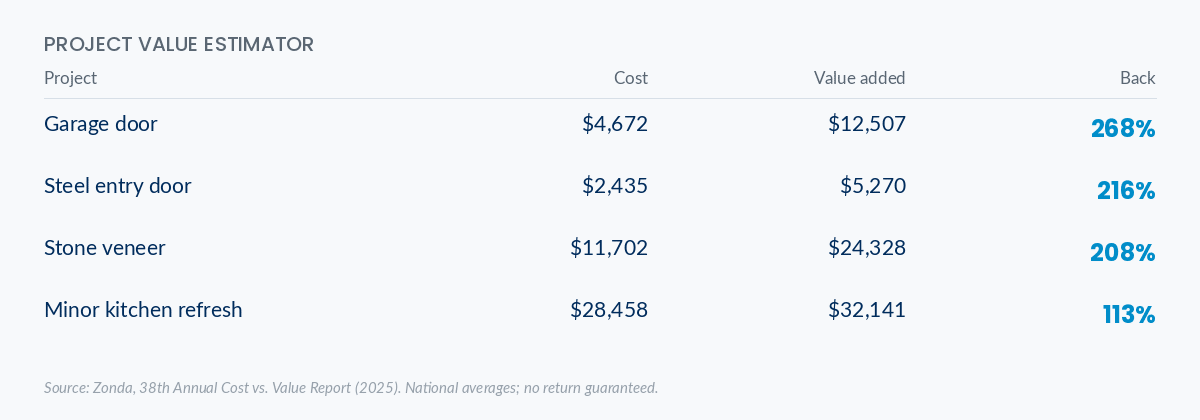
1. Garage door replacement. First place, two years running, and it isn’t close. Average cost is $4,672 and it adds an average of $12,507 in resale value. That’s roughly 268% of what you put in.
It’s an odd winner until you think about how a house is actually seen. On most homes the garage door is the single largest visible surface from the street. A dented, faded, original-to-1998 door quietly ages the whole front of the house, and a new one quietly un-ages it. It’s a one-day job.
2. Steel entry door replacement. Second, at about 216%. Average cost $2,435, returning around $5,270. It’s the smallest job on the entire list.
A front door is the one part of the house every single visitor touches. If yours sticks, rattles, or has a draft you’ve stopped noticing, that’s the impression people are forming while they wait for you to open it.
3. Manufactured stone veneer. Third, at roughly 208%. Costs about $11,702 and adds about $24,328. This is usually a partial application, on a front facade or around an entry, rather than the whole house.
4. Fiber-cement siding replacement. About 114%. At roughly $21,485 it’s a considerably bigger job than the three above it, and it still returns more than it costs. It also solves maintenance problems rather than just cosmetic ones, which is worth something the report doesn’t measure.
5. Minor kitchen remodel. About 113%, at around $28,458. New cabinet fronts, new hardware, new counters, updated sink and fixtures. Crucially, this is not a tear-out. The layout stays. The plumbing stays.
It’s the only interior project in the entire top five, and it beats a full gut renovation by an enormous margin. If you’ve been putting off the kitchen because you assumed the only option was the expensive one, this is the finding worth knowing about.
What people tend to regret
Large additions and full kitchen gut renovations sit near the bottom of the same list.
That deserves a fair hearing, because “regret” is the wrong word if you’re staying put. A primary suite addition that gives your family another decade of comfortably living in a house you love is a good decision, whatever the resale math says. Zonda’s own editors make this point… large interior remodels are often too subjective to return the same value at resale, but they make the most sense for people planning to stay a long while.
The trouble is when people take on a big interior project expecting it to come back at closing. That’s where the disappointment lives. Not in the project. In the expectation attached to it.
The real split
Here’s the cleanest way to think about all of it.
Exterior projects pay you back when you sell. Interior projects pay you back while you live there.
Both are legitimate. They’re just not the same decision, and the honest first question is which one you’re actually making. If you’re planning to list in the next couple of years, the top of that list is where your money works hardest. If you’re planning to stay ten years and the kitchen makes you unhappy every single morning, fix the kitchen and stop reading ROI tables.
Why fall is the moment
Most of this work needs dry, moderate temperatures. Roofing, siding, exterior painting and deck work all depend on it, and once the weather turns you’re into freeze-thaw season when a lot of it simply can’t be done well.
The scheduling piece matters more than people expect. Contractor calendars fill quickly as autumn gets going, and homeowners who wait end up compressed against winter deadlines, which is where rushed work and inflated quotes come from. Booking in early fall usually gets you a better crew, a better price, and a project that finishes before the cold does.
Your fall project shortlist
Walk the outside of your house and check off what applies. Then take this to whoever you’re getting quotes from.
- ☐ Garage door. Is it original to the house? Dented, sagging, noisy, or a different white than everything else?
- ☐ Front door. Does it seal, latch cleanly, and look like it belongs to the same house as the rest of the trim?
- ☐ Siding and trim. Any soft spots, gaps at the joints, or paint failing on the sun-facing side?
- ☐ Entry facade. Would partial stone or a rebuilt surround change how the front reads from the curb?
- ☐ Kitchen. Could fronts, hardware and counters get you most of what you wanted from a gut job?
- ☐ Get quotes before October. Ask every contractor how far out they’re currently booking.
Rough cost tiers, from the same report. Under $5,000 covers a garage door or an entry door. $10,000 to $15,000 gets you into stone veneer. $20,000 and above is siding and a minor kitchen refresh.
Paying for it
Most people funding a project this size are choosing between savings, a card, a personal loan, or borrowing against the equity in the house. Those are genuinely different tools with different costs and different consequences, and the right one depends heavily on how long you plan to stay and what else is on your balance sheet.
That’s a conversation worth having before you sign a contract rather than after. We’re happy to walk through the options with you and tell you honestly if borrowing isn’t the right move. Sometimes it isn’t.
Questions we get asked
Does a new roof pay for itself? Roofing didn’t crack the top ten this year, but it’s rarely a discretionary choice. A failing roof isn’t an ROI decision, it’s a condition issue that can hold up a sale or an appraisal entirely.
Is solar worth it? Rooftop solar was newly added to the report this year and the payoff varies widely by market and utility. It’s one where local numbers matter far more than national averages.
What about a basement? Basement remodels were also new this year, and of the recent additions they showed the most consistent return nationwide.
Should I do any of this if I’m not selling? Only if you want it. Everything above is measured against resale value. If you’re staying, the better question is what you’ll enjoy, and whether it’s worth the cost to you.
Source: Zonda, 38th Annual Cost vs. Value Report, published September 18, 2025. Figures are national averages and vary considerably by local market; Atlanta-area numbers will differ. MiLEND does not provide contracting, appraisal, or investment advice, and no return on any home improvement is guaranteed. MiLEND, Inc. NMLS #148769. Equal Housing Lender.