

Key takeaways
- Good contractors book up fast once the weather turns. The homeowners who get bids and line up the money in winter get on the calendar first.
- Most bigger jobs are paid in stages: a deposit, payments at milestones, and a final payment. Plan your money around that schedule, not one big check.
- Budget for surprises before the first wall comes down. Almost every project turns one up.
- A home equity line of credit (HELOC) fits staged projects well. You use it as each payment comes due, and your first mortgage stays exactly as it is.
- Each project has its own homework: layout for a kitchen, insurance and warranties for a roof, moisture and permits for a basement.
Spring is when everyone wants the work done, which is exactly why winter is when it gets planned. By the time the weather turns, the best roofers, kitchen crews and contractors already have their calendars filling up, and a call in April can easily mean a start date in July.
The homeowners who get the good contractors and the early dates are usually the ones who already have bids, a budget and the money lined up before the first warm weekend. If there’s a project on your list for this spring, here’s how I’d use the next couple of months.
Why winter is the planning season
Contractors fill their spring calendars early, and the good ones fill first. Roofers, siding crews and landscapers are the obvious ones, but kitchen and bath contractors book out too, especially for projects that need custom cabinets or counters with long lead times.
Winter also gives you something spring won’t: time to think. You can get several bids without rushing, compare them line by line, and sort out how you’ll pay before anyone needs a deposit. Decisions made in January at the kitchen table almost always cost less than decisions made in May with a crew waiting.
Step one: get real bids
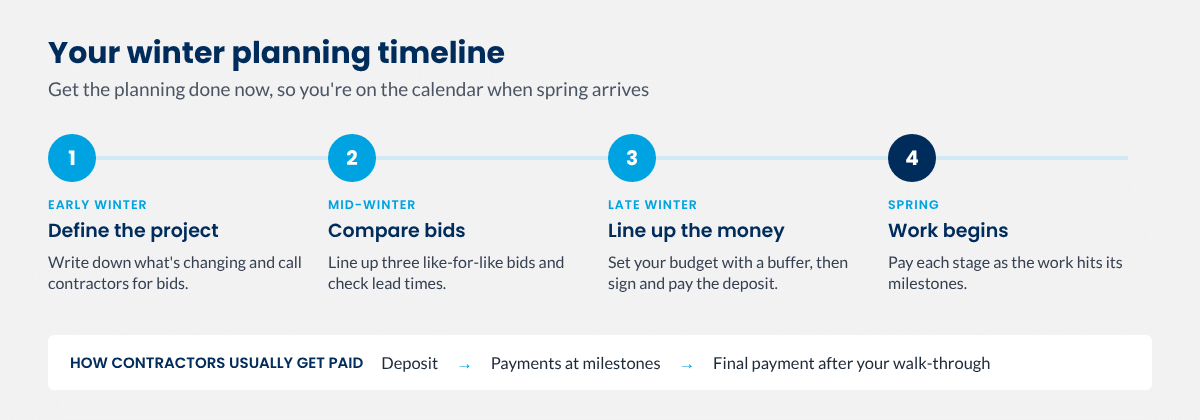
Start with what you want done, written down as clearly as you can. The more specific you are, the easier it is to compare bids, because every contractor is pricing the same job instead of their own version of it.
Get at least three bids for any bigger project. Make sure each one covers the same work, materials and cleanup, and ask what’s not included, since that’s often where the surprises hide. Check that each contractor is licensed and insured for the work, and ask for a couple of recent customers you can call.
Step two: understand how contractors get paid
Most bigger jobs follow a payment schedule. There’s usually a deposit to get on the calendar and order materials, then payments as the work hits set milestones, and a final payment when the job is finished and you’ve walked through it. The schedule should be written into the contract before any work starts.
Be careful with any contractor who wants most of the money up front, and check your state’s rules, since some states limit how big a deposit can be. Holding back the final payment until the work is done and you’re happy with it is standard, and it’s your best leverage if something needs fixing.
Step three: plan for surprises
Almost every project turns up something nobody planned for. Old wiring behind a wall, soft subfloor under the tile, a pipe that isn’t where the drawings said. A smart budget assumes one of those will happen and sets money aside for it before work starts, so a surprise in week three doesn’t turn into a scramble.
A lot of homeowners plan for a buffer on top of the bid and size their financing with that buffer included. If you don’t need it, you don’t use it. If you do, you’re not making a rushed money decision with a half-finished room behind you.
Step four: line up the money before you sign
Having your financing in place before you sign a contract puts you in a stronger spot. You know your real budget before the bids come in, you can say yes to a good contractor while they still have openings, and you’re not filling out a loan application while a crew waits on a deposit.
There’s more than one way to pay for a project, and each one costs something different. Savings, credit cards, personal loans, contractor financing and home equity all have a place, and we walked through all of them in Got the project list? There’s more than one way to pay for it.
Why a HELOC fits a staged project
A home equity line of credit is built for costs that come in pieces. Instead of borrowing the whole amount on day one and paying interest on all of it while the work is still months away, you use the line as each payment comes due: the deposit in March, the progress payment in April, the final payment when the job is done. You pay interest on what you’ve actually used.
A HELOC also sits alongside your first mortgage. If you locked in a low rate a few years ago, that mortgage, its rate and its payment stay exactly as they are. That’s a big reason so many homeowners are using equity this way instead of refinancing, and you can read more about it in Keep Your First Mortgage and Still Use Your Equity.
Sizing the line with your buffer included means the surprise in week three is already covered. If the project comes in on budget, the rest of the line simply isn’t used.
Project notes: kitchens, roofs and basements
The kitchen. Kitchen costs climb fastest when the layout changes. Keeping the sink, stove and refrigerator where they are and replacing cabinets, counters, flooring and lighting usually costs a lot less than moving plumbing, gas lines or walls. Decide early which kind of kitchen project you’re doing, because it changes every bid you’ll get.
Ask each contractor about lead times on cabinets and counters, since custom pieces can take weeks to arrive and often set the pace for the whole job. Plan for a few weeks without a working kitchen too. A temporary setup with a microwave, a coffee maker and a folding table makes that stretch a lot easier on the household.
The roof and exterior. Before you pay for a new roof yourself, find out whether storm damage is part of the problem. If it is, your homeowners insurance may cover some of the cost, and most roofers can tell you during the estimate whether a claim makes sense. Call your insurance company before the work starts, not after.
Ask every roofer about the warranty, both on the materials and on their own workmanship, and get both in writing. The same goes for siding and windows. Exterior projects also depend on the weather, so build a little flexibility into the schedule and the payment dates.
The basement. Finishing a basement can add a lot of usable space, but the first job is making sure it stays dry. Any water or moisture problem needs to be fixed before walls, insulation and flooring go in, or it’ll show up again later behind the new drywall.
Pull the right permits so the work counts when you sell. If you want a bedroom down there, plan for a window or door big enough to get out through in an emergency, since most building codes require one. Basements also tend to turn up surprises once the work starts, from wiring that needs updating to old paneling hiding moisture, which is exactly the kind of thing your buffer is for.
A note about taxes
The interest on a home equity loan or line may be tax-deductible when you use the money to buy, build or substantially improve the home that secures the loan. Rules and limits apply, and everyone’s situation is different, so check with your tax professional before you count on it.
Your winter planning checklist
- ☐ Write down the project as specifically as you can: what’s changing, what’s staying.
- ☐ Call contractors now for bids, and get at least three that cover the same work.
- ☐ Ask about lead times on materials, especially cabinets, counters and windows.
- ☐ Check insurance first on any roof or storm-related repair.
- ☐ Read the payment schedule in every contract, and don’t pay most of it up front.
- ☐ Add a buffer on top of the bid for the surprises.
- ☐ Line up the money before you sign, sized with the buffer included.
- ☐ Ask about permits for anything structural, electrical or in the basement.
Questions I get asked
When should I start calling contractors? Now is a good time for most spring projects. Winter is slower for a lot of trades, so you’ll usually get faster callbacks and more time with each contractor during the bid.
Should I get financing before or after I have bids? Start the conversation before, and finalize once you have the bids in hand. A rough budget helps you know which bids are realistic, and having the money lined up before you sign means you can move as soon as you pick a contractor.
Do I have to refinance my mortgage to pay for a project? No. A HELOC or home equity loan sits alongside the mortgage you already have, so your first mortgage, its rate and its payment don’t change.
What if the project comes in under budget? With a line of credit, you only use what the project actually costs. Anything left on the line stays available for the next project or a surprise down the road.
How much equity do I have to work with? Your loan officer can look at that with you, or you can get a rough estimate in about a minute with our Equity Explorer.
Where to start
If something’s on your list for this spring, start with the bids and a phone call. Give me a call and we’ll talk through your project, what it’s likely to cost, and the best way to have the money ready before the first contractor shows up. You can also reach us through our contact page or at (855) 645-3631.
This page is general information, not a commitment to lend or an offer of credit. Loans are subject to credit approval, and what you may qualify for depends on your credit, income, home value and current mortgage.