

Financing Options

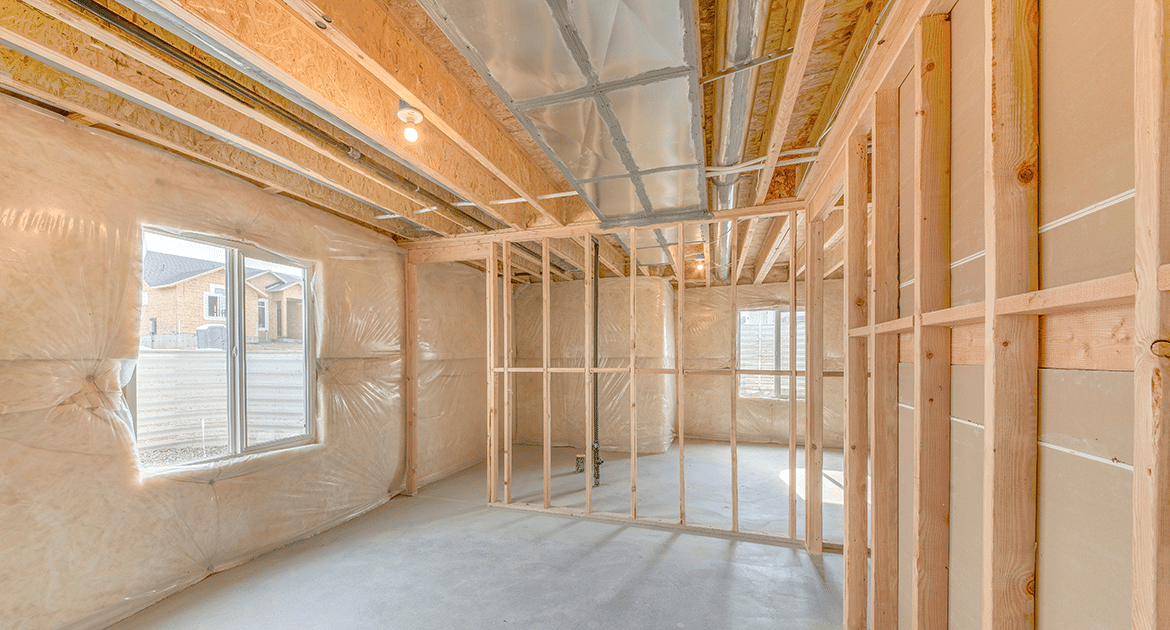
An unfinished basement framed with new wood studs and insulated walls, daylight coming through a window

The In-Law Suite Most People Price Wrong

The In-Law Suite Most People Price Wrong 1200 630 Creative Studio

Key takeaways

  • Converting space you already own is usually cheaper than building a separate unit in the backyard, and most homeowners price the backyard version first.
  • Atlanta currently allows only detached accessory units, which means basement apartments and garage conversions aren’t permitted in the city today.
  • The Atlanta Department of City Planning has proposed allowing attached conversions, but that change hasn’t been adopted and is still moving through review.
  • Accessory dwelling rules are written city by city and sometimes tightened further by an HOA, so the only answer that counts is the one from your own jurisdiction.
  • A cash-out refinance and a home equity line are the two routes I can help with directly, and which one fits depends on your situation and what you qualify for.

A client called me last month because her mother is moving down from Ohio. She’d been going back and forth about it for the better part of a year, and she’d landed where a lot of families land. She wanted her mom close by, but she didn’t want her mom living in the guest room off the hallway. Both of them wanted a door that closes and a kitchen that belongs to somebody. So, she’d gotten a quote on a small cottage for the backyard, and the number came back high enough that she called me half convinced the whole idea was finished.

I asked her one question before we talked about money at all, which was what she had above her garage. There was a full floor up there, unfinished, holding a Christmas tree and a treadmill nobody had touched in three years. She’d priced the most expensive version of what she wanted without ever looking at the cheaper one sitting over her own cars, and in my experience that’s how it usually goes.

The expensive version is the one people price first

The phrase the industry uses for a second living space on your property is accessory dwelling unit, which is a clumsy name for a simple thing: somewhere smaller to live, on the same lot as the main house. An in-law suite is one. So is a garage apartment, a finished basement with its own entrance, and the little cottage at the back of the lot that people’s grandparents called a granny flat.

When somebody pictures an accessory unit, they almost always picture the cottage. It’s the version that shows up in magazines and the version builders put on their websites, and it’s also the version that requires a foundation, a roof, new plumbing runs and a new electrical service. Every one of those is a line item that a conversion of existing space either skips entirely or handles far more cheaply.

Cities that have allowed accessory units for years show which version homeowners actually choose. The Atlanta Department of City Planning, comparing our rules to other cities, points out that in Los Angeles nearly four out of every five accessory units are conversions or expansions of space that already existed. Only one in five are detached buildings. Given a real choice between the two, most homeowners don’t build in the yard.

I’m not telling you the cottage is a bad idea. If your basement is four feet tall and your garage is falling down, the yard may be your only option. I’m telling you that most people never price the comparison, and the comparison is where the money is.

What people actually want the space for

People’s reasons for wanting an in-law suite are more mixed than the internet suggests. The pitch online is almost always rental income, and income is part of it for a lot of families. It’s rarely the whole story, and in my office it’s usually not the part that started the conversation. What starts it is a parent, or a kid who moved home, or a sister between houses.

When Freddie Mac asked homeowners in 2022 why they’d want one, the most common answer wasn’t income at all. It was having somewhere to put out-of-town visitors. Renting came next, and moving family in came after that. People could pick more than one reason, so the shares add up to well past 100, and plenty of them had a family reason and an income reason at the same time.
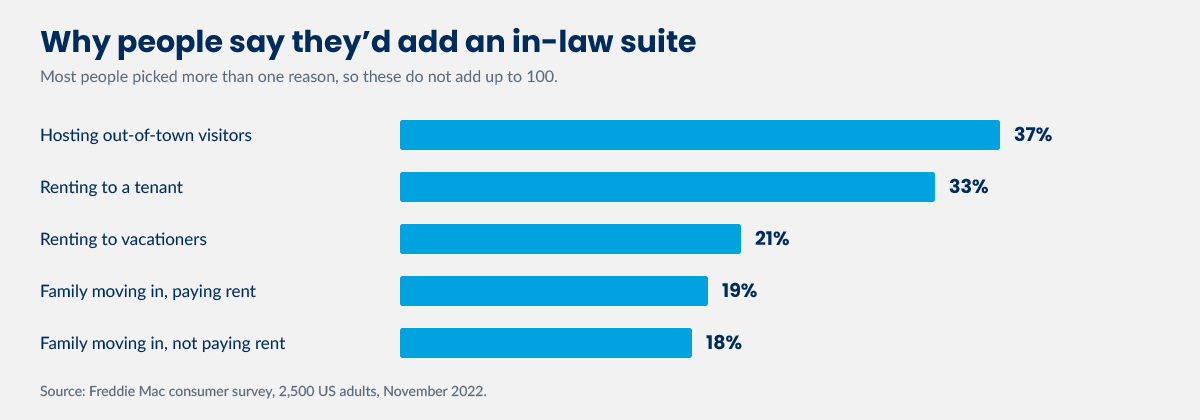
Bar chart of the top reasons people would consider an accessory dwelling unit, from a Freddie Mac consumer survey: hosting out-of-town visitors 37 percent, renting to tenants 33 percent, renting to vacationers 21 percent, moving family in permanently with rent 19 percent, moving family in temporarily without rent 18 percent

Two other surveys point the same way. AARP’s 2024 survey of adults found that one in four older homeowners say they would consider building an accessory unit to provide space for a loved one who needs care or a place to live. The Census Bureau counted 6.0 million American households in 2020 with three or more generations under one roof, up from 5.1 million a decade earlier, and that was 7.2 percent of all family households. Families are spreading across fewer addresses than they used to, and the house is where that gets absorbed.

What Atlanta allows right now

Atlanta’s rules need spelling out precisely, because the answer changes at almost every city limit. What follows is true inside the Atlanta city limits and nowhere else. If you’re in Marietta or Decatur or unincorporated Gwinnett, read it as an illustration of how much these rules vary rather than as your answer.

In Atlanta today, you can build a detached accessory unit without asking the city for special permission, as long as your property sits in one of the residential zones the code lists (R4, R4A and R5) plus a handful of special districts. That’s the city’s own description of its current code. The unit has to be its own building, separate from the house, and it can’t be split off and sold as its own lot.

Notice what’s missing from Atlanta’s current rules. Atlanta doesn’t currently allow the accessory unit to be attached to the main house. A basement apartment with its own entrance and an apartment carved out of an attached garage, the two cheapest versions of this, aren’t on the table inside the city right now. The city’s planning department says so plainly, and names it as the thing that makes Atlanta an outlier: limiting homeowners to detached units limits them to the more expensive option. So, if you live in the city and somebody has told you to just finish the basement and put a door on it, that advice is out of date, or it came from somewhere else.

What the city has proposed, and what that means for timing

The Department of City Planning has put forward a set of changes, and they go directly at that gap. The proposal would allow accessory units attached to the main dwelling, specifically naming a basement apartment or a garage conversion, capped at half the size of the main house or 1,000 square feet. It would raise the size limit on detached units from 750 to 1,000 square feet, raise the height limit from 20 to 24 feet so a unit over a garage becomes possible, extend the allowance to the R4B district, and stop counting garage space against the unit’s square footage.

None of those proposed changes is law yet. The proposal sits inside the city’s larger zoning rewrite and is still working through the review process, which means neighborhood review, a zoning board hearing and a City Council vote before anything changes. I’m not going to guess at the timing, and you should be suspicious of anyone who does.

The practical consequence for an Atlanta homeowner is that the calendar matters. If the conversion you want is attached, the answer today is no, and it may not be no forever.

What actually stops these projects

Every one of these projects runs into the same wall, and the wall is permission rather than money. Permission is what people check last, and it’s what they should be checking first.

Accessory dwelling rules are written city by city and county by county. Two houses four miles apart can sit under completely different rules, and an HOA can tighten things further on top of whatever the city allows, including banning a separate kitchen or a separate entrance outright. I can’t tell you what your jurisdiction permits, and neither can a contractor who works across three counties, and neither can a website. You have to ask your own planning department and read your own covenants.

The other thing that stops these projects is whether the space can actually work. A separate entrance, ceiling height that meets code, a way to run water and waste to a new kitchen and bathroom, and enough of a footprint that somebody can live there without walking through your living room. Plenty of basements fail on ceiling height alone. Better to learn that in week one than in month four.

Paying for it

Paying for the work is the part clients ask me about, so let me be straight about what I can and can’t help with. I went through all five ways people pay for a project like this a couple of weeks back, and I won’t put you through it twice. That whole comparison is still up on the blog if you want the long version.

The two routes I work with are a cash-out refinance, where you replace your current mortgage with a larger one and take the difference in cash, and a home equity line of credit, which is a second loan against the house that you draw on as you need it rather than taking all at once. Which of those makes sense depends on your current mortgage, how much equity you have, and what the work is likely to cost. What you’d qualify for varies by program, by property and by borrower.

Rolling other debts into the mortgage is the one I want to warn you about. If you’re thinking about folding existing balances in while you borrow for the conversion, know that debts your house isn’t currently backing become debts it is backing, and stretching them over a mortgage’s length can mean paying more interest overall even when your monthly payment drops. That’s a real trade, and I’d want to walk through it with you before you decide.

Before you call anyone, work through this

Most of the wasted money on these projects gets spent in the first month, on plans for something that was never going to be allowed. Run this list first.

  • ☐  Find your zoning district on your city or county’s online zoning map
  • ☐  Call your local planning department and ask specifically whether an attached accessory unit is permitted in your district
  • ☐  If you’re in an HOA, read the covenants for language on separate kitchens, separate entrances and rental of any part of the property
  • ☐  Measure the finished ceiling height of the space you have in mind and check it against your local code minimum
  • ☐  Identify where water and waste would connect for a new kitchen and bathroom, and get a plumber’s opinion before an architect’s
  • ☐  Confirm whether the space would need its own entrance and whether you have somewhere to put one
  • ☐  Get two quotes on the conversion and one on the detached version, so you’re comparing rather than guessing
  • ☐  Work out how much equity you have before you decide how the work gets paid for

Take the list to your planning department before you take it to a builder. The answers are free, they take one phone call, and they determine everything that comes after.

If you want to talk through the financing side once you know what your city allows, give me a call. I’d rather help you work out what’s realistic now than fix a plan that was built on the wrong rules.


Photo of modern architectural style condos, perfect for investors or Airbnb owners looking to add a new rental, with palm trees against a clear blue sky with clouds.

Loan-to-Value Ratio for Investment Properties

Loan-to-Value Ratio for Investment Properties 5264 3393 Your Loan Officer for Life

Key Takeaways

  • The LTV formula and how to calculate it for any property 
  • Maximum LTV by loan program and property type 
  • What combined loan-to-value (CLTV) means once a second loan is involved 
  • How LTV and DSCR work together for investment property qualification 
  • Practical ways to improve your LTV position before you apply 


What Is Loan-to-Value (LTV)? 

Loan-to-value measures how much you’re borrowing relative to what the property is worth: 

LTV = Loan Amount ÷ Property Value × 100 

If you’re purchasing a $500,000 property with a $400,000 loan, your LTV is 80% — meaning the lender is financing 80% of the deal, and you’re covering the remaining 20% through your down payment or existing equity. 

The lower your LTV, the more equity you’re bringing into the deal, and the less risk the lender is carrying. That relationship is why LTV drives so much of your loan’s pricing and structure. 

Why LTV Determines More Than Just Your Down Payment 

Interest rate: A lower LTV generally unlocks better pricing, since less equity means more risk priced into the rate. 

Mortgage insurance: On most conventional financing, an LTV above 80% typically triggers private mortgage insurance (PMI) — an added monthly cost that continues until your LTV drops back below that threshold, either through paying down principal or the property appreciating. 

Approval speed and flexibility: Lower-LTV deals are generally viewed as lower-risk, which can mean a smoother underwriting process and more room to negotiate terms. 

Available loan amount: Your LTV cap, combined with the property’s appraised value, sets the ceiling on how much you can actually borrow — which is often the real constraint on what property you can afford, more than your income alone. 

Maximum LTV by Property Type 

LTV limits aren’t uniform — they shift meaningfully based on what you’re financing and how the property will be used: 

Property Type Typical Maximum LTV 
Owner-occupied, Conventional Up to 97% 
Owner-occupied, FHA Up to 96.5% 
Owner-occupied, VA (eligible borrowers) Up to 100% 
Owner-occupied, USDA (eligible areas) Up to 100% 
Investment property, 1 unit Roughly 75–85% 
Investment property, 2–4 units Roughly 70–75% 
Cash-out refinance, investment property Roughly 70–75% 
Jumbo financing Roughly 80–85%, program-dependent 

These are general industry ranges, not guaranteed figures — actual maximum LTV depends on your credit profile, the specific loan program, and current underwriting guidelines. Confirm your exact number with a loan officer before you make an offer. 

Notice the pattern: investment properties consistently carry lower maximum LTVs than owner-occupied homes, meaning more of your own capital is required upfront. That’s a direct reflection of risk — a lender absorbs more exposure on a property you don’t live in. 

Combined Loan-to-Value (CLTV): When a Second Loan Enters the Picture 

If you’re carrying more than one loan against a property — most commonly a first mortgage plus a HELOC or home equity loan — lenders evaluate combined loan-to-value (CLTV) instead of LTV alone: 

CLTV = (Sum of All Loan Balances) ÷ Property Value × 100 

This matters directly if you’re planning to tap equity in an investment property to fund a down payment on another one, or to cover renovation costs. Your CLTV, not just your primary mortgage’s LTV, is what determines how much additional borrowing capacity you actually have. 

How LTV Shifts Across the Property Lifecycle 

LTV isn’t a static number — it moves every time your loan balance or your property’s value changes, and tracking that shift is where informed investors gain an edge: 

  • At purchase, LTV is set by your down payment relative to the purchase price or appraised value, whichever is lower. 
  • As you pay down principal, LTV drops steadily even if the property’s value stays flat — every payment shifts more of the deal into equity. 
  • As the property appreciates, LTV drops independent of your payment schedule, which is often the faster lever in a rising market. 
  • At refinance, the lender reappraises the property and recalculates LTV from scratch — which is the point where prior paydown and appreciation either unlock better pricing, eliminate mortgage insurance, or open up cash-out capacity. 


This is also where owner-occupied and investment property LTV genuinely diverge in practice. An owner-occupied home benefits from the full range of high-LTV programs (FHA, VA, USDA, high-LTV Conventional). Investment properties don’t have that same low-down-payment runway — which means the equity-building levers above (principal paydown, appreciation, strategic pricing at purchase) carry more weight for investors than they do for owner-occupants, since there’s less room to lean on program flexibility alone. 

How to Improve Your LTV Position 

  • Increase your down payment if your capital position allows it — the most direct lever available. 
  • Choose a property priced below appraised value, which immediately improves your LTV at closing without adding more cash. 
  • Pay down principal over time on an existing loan to lower LTV ahead of a future cash-out refinance. 
  • Let appreciation work in your favor — a property that’s gained value since purchase may already sit at a lower LTV than your original loan terms, which can unlock refinancing options like eliminating PMI or accessing better pricing. 
  • Track your position with a mortgage calculator before you start shopping, so you know your target purchase price range at your desired LTV. 


The Bottom Line 

LTV isn’t just an underwriting formula — it’s the number that determines your down payment, your rate, your mortgage insurance exposure, and ultimately how much of your own capital stays available for your next deal. Investment properties carry tighter LTV limits than owner-occupied homes by design, which makes getting this number right before you make an offer more important, not less. 

Milend has been structuring exactly this kind of financing since 1995. As a family-owned, Atlanta-based lender, we underwrite across FHA, VA, Conventional, Jumbo, and investment property purchase and refinance programs — which means your LTV target is matched to the program built for it, not a one-size-fits-all number. 


Questions I get asked?

What is a good LTV ratio for an investment property?

Most investment property financing caps out lower than owner-occupied lending — generally in the 75–85% range for a single unit and 70–75% for 2–4 unit properties. A lower LTV, meaning a larger down payment, typically unlocks better pricing and avoids or reduces mortgage insurance costs. 

How is LTV calculated?

LTV is calculated by dividing the loan amount by the property’s value (either the purchase price or appraised value, whichever is lower for a purchase transaction), then multiplying by 100 to get a percentage. A $400,000 loan on a $500,000 property is an 80% LTV. 

What’s the difference between LTV and CLTV?

LTV considers only a single loan against the property. Combined loan-to-value (CLTV) adds together all loan balances secured by the property — such as a first mortgage plus a HELOC — and divides that total by the property’s value. CLTV is the relevant number whenever more than one loan is secured against the same property. 

Does LTV affect my interest rate?

Yes. A lower LTV generally signals lower risk to a lender, which typically translates into more favorable interest rate pricing. A higher LTV usually means a higher rate and, on many conventional loans, added mortgage insurance costs. 

What LTV do I need to avoid PMI? 

On most conventional financing, keeping your LTV at or below 80% typically avoids private mortgage insurance. Above that threshold, PMI is usually required until your LTV is paid or appreciated back down below 80%. 

What’s the maximum LTV for a jumbo loan?

Jumbo financing typically allows LTV up to roughly 80–85%, though the exact maximum depends on the loan amount, property type, and lender guidelines, and can be tighter than conforming loan limits allow. 

Investment Property Loans: Requirements, Down Payments, and How to Qualify

Investment Property Loans: Requirements, Down Payments, and How to Qualify 1949 1099 Your Loan Officer for Life

Key Takeaways

  • What actually qualifies as an investment property versus a second home 
  • Down payment, credit score, and DTI requirements by property type 
  • How lenders treat rental income when calculating what you qualify for 
  • Loan program options, including a lower-down-payment path most investors overlook 
  • How many financed properties you can realistically carry at once 


Financing an investment property follows the same basic mortgage process as buying a home you’ll live in — you apply, document your finances, and get underwritten. The differences show up in the details: larger down payments, closer scrutiny of your reserves, and rules around how much of your expected rental income actually counts toward qualifying. Understanding those differences before you start house hunting is what keeps your offer realistic and your closing on schedule. 

What Counts as an Investment Property? 

An investment property can be a single-family residence, a multi-unit property, or a condominium — most commonly used as a rental, though it can also serve as a second home for your family. The distinction that matters to underwriting isn’t the property type; it’s occupancy. If you won’t be living there, it’s evaluated as non-owner-occupied financing, which carries different terms than the mortgage on your primary residence. 

Down Payment and LTV Requirements 

Investment properties require more equity upfront than owner-occupied homes — this is the single biggest structural difference in the financing: 

  • Single-family investment property: typically 15% minimum down, though 20–25% is common depending on your credit profile and the lender 
  • 2–4 unit investment property: typically 25% minimum down 
  • No PMI safety net: unlike owner-occupied financing, private mortgage insurance generally isn’t available on investment properties, so the higher down payment isn’t optional — it’s the lender’s primary protection against risk 


For a deeper look at how your down payment translates into loan-to-value ratio and what that means for your rate and terms, see our guide on loan-to-value ratio for investment properties. 

Credit Score and DTI Requirements 

Lenders generally expect a stronger credit and income profile for investment property financing than for a primary residence: 

  • Credit score: while some conventional guidelines technically allow scores in the 620s, most lenders want to see 680 or higher before extending competitive pricing on a rental property loan 
  • Debt-to-income ratio (DTI): generally capped around 43–45%, calculated the same way as any mortgage — total monthly debt obligations divided by gross monthly income 


A stronger credit profile doesn’t just affect approval odds — it directly affects your rate, since investment property pricing already runs roughly 0.5–0.75 percentage points above owner-occupied rates industry-wide. 

Cash Reserve Requirements 

Reserves get more scrutiny on investment property financing than on a primary home purchase. Most lenders want to see six months of mortgage payments (principal, interest, taxes, and insurance) available in liquid or near-liquid assets after your down payment and closing costs are covered. If you already carry financing on other investment properties, expect reserve requirements to stack across your portfolio rather than reset with each new purchase. 

Using Rental Income to Qualify 

Expected rental income can help you qualify for an investment property loan, but lenders don’t count it dollar-for-dollar. Most guidelines only credit roughly 75% of projected rent toward your qualifying income, building in a cushion for vacancy and maintenance. A signed lease on the property, if one exists, strengthens your case further. This is a detail worth running by your loan officer early — it can materially change your qualifying numbers versus what you’d assume from gross rent alone. 

Loan Program Options 

Conventional financing is the most common route for 1–4 unit investment properties, offering predictable fixed-rate terms and no occupancy requirement. 

FHA and VA “house hacking” is a lower-down-payment path many investors overlook: if you purchase a 2–4 unit property and occupy one unit yourself, you can use owner-occupied financing — FHA at as little as 3.5% down, or VA at 0% down for eligible borrowers — while renting out the remaining units. This is genuinely one of the more accessible ways into a first investment property, though it does require living in the property, typically for at least a year. 

Jumbo financing applies once your loan amount exceeds conforming limits, which is common with higher-value investment properties or multi-unit purchases in competitive markets. See our Jumbo loan program for details. 

Tapping existing equity is another path worth considering if you already own a home: a HELOC or cash-out refinance on your current property can fund the down payment on your next one, consolidating your financing into a structure that fits your broader portfolio strategy. 

Note: some lenders in the market also offer DSCR loans, which qualify borrowers based on the property’s rental income rather than personal income or tax returns. This can be worth exploring for self-employed investors or those with complex income — ask your loan officer whether this fits your situation. 

How Many Investment Properties Can You Finance? 

Under standard conventional guidelines, investors are generally limited to 10 financed properties total, including your primary residence. Once you’re carrying more than four financed properties, expect stricter requirements across the board: higher down payments, tighter credit score minimums, and more extensive reserve documentation. This is worth planning for early if you’re building a multi-property portfolio rather than buying a single rental. 

The Bottom Line 

Investment property financing isn’t harder because lenders are being difficult — it’s structured around real risk differences between a home you live in and one you don’t. Knowing the actual down payment, reserve, and income requirements before you start shopping is what keeps your offer competitive and your closing timeline realistic. 

Milend has been guiding investors through exactly this kind of financing since 1995. As a family-owned, Atlanta-based lender, we handle investment property financing from pre-qualification through the end of escrow — and if you already own a rental and it’s time to revisit your terms, our investment property refinance team can walk you through that too. 

What I commonly get asked?

What is the minimum down payment for an investment property?

Conventional financing typically requires at least 15% down for a single-family investment property and 25% for a 2–4 unit property. Some lenders may require 20% or more depending on your credit profile, since PMI generally isn’t available on investment properties. 

Can I use rental income to qualify for an investment property loan?

Yes, but most lenders only count roughly 75% of the projected rent toward your qualifying income, to account for vacancy and maintenance costs. A signed lease can strengthen your application further. 

How much in cash reserves do I need for an investment property?

Most lenders require six months of mortgage payments (principal, interest, taxes, and insurance) in reserves after your down payment and closing costs, and that requirement can increase if you already hold financing on other investment properties. 

Can I buy an investment property with less than 20% down?

Yes, in certain cases. Some conventional programs allow as little as 15% down for a single-unit property with strong credit. Additionally, purchasing a 2–4 unit property and occupying one unit yourself opens the door to FHA financing at 3.5% down or VA financing at 0% down for eligible borrowers. 

How many investment properties can I finance at once?

Under standard conventional guidelines, investors can typically finance up to 10 properties total, including their primary residence. Requirements become stricter — higher down payments, higher credit score minimums, more reserves — once you exceed four financed properties. 

Is the interest rate higher for an investment property loan?

Yes, typically. Investment property rates generally run about 0.5 to 0.75 percentage points higher than rates for the same borrower on a primary residence, reflecting the additional risk lenders take on with non-owner-occupied financing. 

Photograph of a brick red house with white window trim against a mountain cliff with a potted fern and trees along the driveway.

Creative Financing Options for Home Buyers

Creative Financing Options for Home Buyers 3456 2592 Your Loan Officer for Life

Key Takeaways

  • Explore Beyond Traditional Mortgages: Discover a range of innovative financing options, including Adjustable-Rate Mortgages (ARMs), FHA loans for first-time buyers, VA loans for veterans, and unique strategies like rent-to-own agreements and seller financing. These options offer flexibility and can make homeownership more accessible.
  • Tailored Solutions for Every Buyer: Whether you’re a first-time homebuyer, a veteran, or someone with a non-traditional income, there’s a financing solution to meet your needs, including easy financing for self-employed individuals, non-warrantable condos, and properties requiring jumbo loans.
  • Financial Preparedness is Key: The path to homeownership starts with financial readiness. Understanding the importance of saving for a down payment, improving your credit score, and budgeting for the ongoing costs of owning a home (like property taxes and maintenance) is crucial.

Owning a home is one of the biggest financial milestones in our lives, and it’s the first real step toward building real prosperity into your financial picture. It’s a place where memories are made, families grow, and personal space is cherished. When interest rates are high, home prices balloon, and everything from groceries to diapers to cars is more expensive than ever before…getting onto or moving up the property ladder can feel like a pipe dream.

The great news in times like these is that traditional mortgage options are not the only path to owning a home. High cost of homes and cost of living are driving eager home buyers, sellers, and home owners looking to refinance to explore creative financing options in droves. So, I’m here to break down some more off-the-wall options to put your home goals back into reach and then help you weigh the pros and cons.

A sheet of paper title Goals for the Year with blank boxes to fill in your goals laid on a grey tablecloth


Understanding Your Needs and Goals

The spring of 2024 is shaping up to be a period of adjustment and opportunity in the real estate market. With the backdrop of the previous year’s trends, we’re looking at a landscape that’s both familiar and full of new potential pathways for buyers and sellers alike.

Traditional Mortgages and Beyond

While traditional 15-year and 30-year mortgages are familiar to most, there are alternatives that offer flexibility and opportunities to save on interest, reduce monthly payments, or both. Let’s explore some creative options:

Adjustable-Rate Mortgages (ARMs): ARMs can be a viable option for those expecting to move or refinance before the interest rate adjusts. Initially, ARMs offer lower interest rates compared to fixed-rate mortgages, potentially saving you money in the short term.

If you’re a blossoming professional looking to buy your first property, need flexibility to travel for work, and expect your income to grow, this can be a good fit and a great entry point into the real estate market.

FHA Loans: Ideal for first-time homebuyers with smaller down payments and less-than-perfect credit scores. FHA helps buyers by insuring the loan so the lenders can offer lower down payments, competitive interest rates, and low closing costs.

These loans are designed to help out first-time homebuyers. The flexibility of having a lower down payment and a shorter or more volatile credit history makes this a great fit for young couples, young families, and single professionals looking to get into their first home.

VA Loans: For veterans, active-duty service members, and some surviving spouses, VA loans provide a path to homeownership with no down payment, no private mortgage insurance (PMI), and competitive rates.

This program is an amazing benefit for veterans and their families, and many veterans that we’ve worked with have completely revolutionized their financial future by getting into a home, or refinancing their existing mortgage into a VA loan.

Creative Financing Techniques

Beyond traditional and government loans, there are several creative strategies to consider:

Rent-to-Own Agreements: This arrangement allows you to rent a home with the option to buy it later. A portion of your rent payments goes toward the purchase price. This can be a great way to build equity and lock in a purchase price while you save for a down payment.

Seller Financing: In some cases, sellers may agree to finance the purchase themselves. This can eliminate traditional lender fees and offer more flexible terms. It’s particularly useful in markets where buyers and sellers are looking for innovative ways to close deals.

Generally, this option has more risk and less reward that many more stable financing options, but if you want to learn more about seller financed properties, check out my in-depth article:

Guide to Owner Financing for Home Buyers

Lease with Option to Purchase: Similar to rent-to-own, this option involves leasing a property with the right to purchase it at a predetermined price before the lease expires. This can be an excellent way to “try before you buy.”

Assumable Mortgages: Assuming the seller’s mortgage can be an option if the current interest rates are higher than the rate of the existing mortgage. This involves taking over the seller’s remaining mortgage balance and terms, potentially saving on closing costs and interest.

Photo of modern architectural style condos, perfect for investors or Airbnb owners looking to add a new rental, with palm trees against a clear blue sky with clouds.


Specialized Lending Programs: A Closer Look

Milend offers specialized lending that we find makes home financing more accessible than most other lenders for self-employed borrowers, non-warrantable condos, and jumbo loans for higher-value properties.

If you have struggled to get financed on an unconventional property type, or with documenting your income, we have some of the most flexible financing options for your needs.

The Importance of Financial Preparedness

Regardless of the financing option you choose, financial preparedness is key. This includes saving for a down payment, improving your credit score, and understanding the full scope of homeownership costs, including property taxes, insurance, maintenance, and utilities.

Young couple, man and woman, pose for a photo in the park. Man is wearing a denim shirt and eyeglasses, hugging the woman from behind. She has shoulder-length brown hair and is wearing a cream sweater and brown tartan scarf.


Personal Success Stories: How Creative Financing Made Dreams Come True

We’ve had the privilege of helping many families navigate the path to homeownership through creative financing. One memorable story is that of a young couple eager to buy their first home but struggling with a limited budget and less-than-stellar credit. Through a combination of an FHA loan, help paying down credit card debt, and in-depth guidance from their Milend loan consultant, they were able to improve their financial standing and purchase a home that fit their needs and budget. Their journey from renters to proud homeowners is a testament to the power of perseverance and the right financing strategy.

Your Next Home is Within Reach

Homeownership is within reach, even if traditional financing options don’t seem like a perfect fit. By exploring creative financing options and preparing financially, you can find a path that aligns with your needs, goals, and financial situation. At Milend, we’re committed to helping you explore all your options and guide you through the process, ensuring you make informed decisions every step of the way.

If you’re ready to take the next step toward homeownership, we’re here to help. Post in the comments or reach out through our Contact page!

Sign up for our newsletter to stay updated on the latest financing tips, success stories, and personalized advice. Let’s make your dream home a reality together.

Let’s Grow Together

As we navigate the spring market and beyond, let’s remember the values that bind us: trust, commitment, personal growth, and the importance of home. If you’re pondering your next move or seeking guidance in the ever-changing real estate landscape, reach out. Together, we can explore your options, prepare for the future, and turn the dream of homeownership into reality.

Stay tuned for more insights, and don’t hesitate to join our community for updates, tips, and stories that celebrate our journeys home, one step at a time.

Understanding Closing Costs: A Homebuyer’s Guide
Read more...
Finding Your Perfect Mortgage Match: A Guide to Making the Right Choice
Read more...